
Strategies on How to Deal with a Narcissist Husband
If you’re wondering how to deal with a narcissist husband, I want you to know you’re not alone, and there are practical steps you can take to protect your emotional well-being. I’ve been working with clients in Portsmouth, NH, and Southern Maine for over 30 years, and my experience has shown that focusing on your own stability is the most effective approach.
I want to be clear from the start: learning how to deal with a narcissist is not about changing them. It’s about reclaiming your sense of self, setting boundaries, and navigating the relationship in ways that keep you safe and grounded. Let’s see the simple strategies that can work for you.
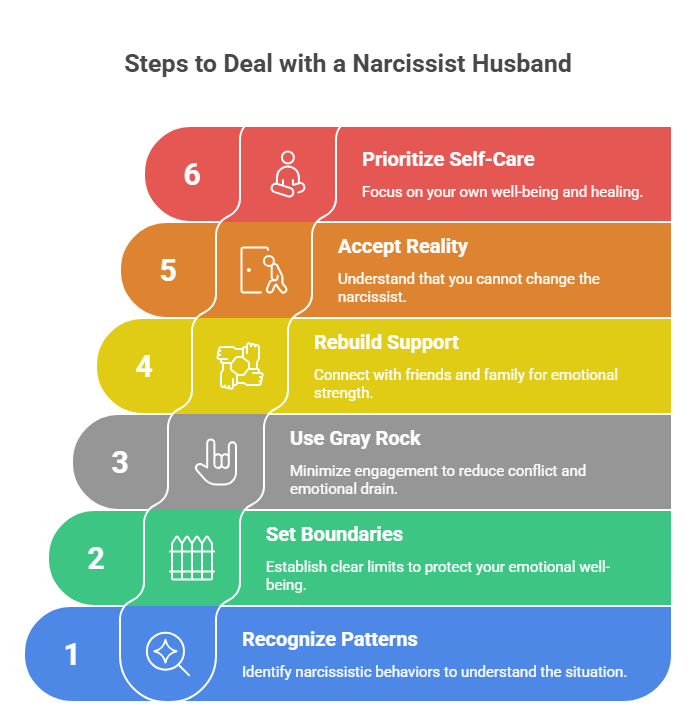
Recognizing Narcissistic Patterns
Before we explore strategies, it helps to understand what narcissistic behavior often looks like. A narcissistic partner may:
- Require constant admiration or validation
- Struggle to accept responsibility
- Minimize or dismiss your emotions
- Turn conflicts into blame or personal attacks
- React defensively to even gentle feedback
When I guide someone through how to deal with a narcissist husband, I often highlight that the goal isn’t to “win” arguments. Instead, it’s about observing the pattern, responding thoughtfully, and protecting your emotional health.
Meanwhile, the situation is not a surprise. A WHO‑based figure suggests roughly 1 in 4 adults globally (24%) report experiencing psychological abuse from an intimate partner at some point in their life.
Setting Boundaries for Your Emotional Safety
One of the first things I encourage is defining and enforcing emotional boundaries. Boundaries clarify what behavior you find acceptable and what you do not. Without them, narcissistic patterns often intensify, leaving you drained and emotionally depleted. Examples of boundaries I suggest include:
- Ending conversations that become insulting or dismissive
- Refusing to engage in circular arguments
- Protecting your personal time and emotional space
- Clearly communicating when behavior feels disrespectful
In my work with couples in Kittery Point, Maine, and the surrounding areas, I often integrate these strategies in couples therapy so partners can practice enforcing limits safely and respectfully.
Using the Gray Rock Method
Another strategy I often teach when discussing how to deal with a narcissist husband is the gray rock method. Narcissistic behavior often thrives on strong emotional reactions: anger, frustration, or visible upset. The gray rock approach is simple: minimize emotional engagement. When using this method, I encourage clients to keep interactions:
- Short
- Neutral
- Focused on facts
- Emotionally steady
For example, instead of entering a heated debate, you might say: “I disagree, and I’m not continuing this conversation.” Then step away.
Rebuilding Your Support Network
Isolation is one of the most damaging aspects of being married to a narcissist. Partners often feel cut off from friends or family, either because of subtle manipulation or overt criticism. Rebuilding a supportive network is essential when learning how to deal with a narcissist husband. I encourage clients to:
- Reconnect with trusted friends or family
- Join support groups
- Seek professional counseling
Professional support is particularly valuable. In Portsmouth, NH, and Southern Maine, I offer relationship counseling to help individuals process confusion, rebuild confidence, and maintain clarity about their own needs and boundaries.
I am a licensed IFS therapist in both Maine and New Hampshire, and much of my work focuses on helping adults understand their internal parts, the different reactions and emotions that arise in response to narcissistic behavior.
Accepting You Cannot “Fix” Them
One realization that can be both freeing and difficult is understanding that you cannot fix a narcissistic partner. Narcissistic traits are deeply ingrained, and expecting them to change often leads to frustration and self-blame. This may include:
- Rebuilding self-esteem
- Understanding internal emotional responses
- Processing past relational wounds, including neglect or trauma
- Developing strong personal boundaries
For clients whose past experiences involve complex trauma or abuse, a sexual abuse therapy can support their healing. These sessions provide tools for restoring self-trust and navigating relationships safely.
Prioritizing Self-Care
I cannot overstate the importance of self-care when dealing with a narcissistic partner. Protecting your mental and emotional health is necessary. I guide clients to focus on:
- Activities that bring joy or restore energy
- Spending time with supportive people
- Reflective practices like journaling or mindfulness
- Engaging in therapy to process internal reactions
Through IFS, I help clients explore how different parts of themselves experience shame, hurt, or fear in response to narcissistic behavior. Understanding these internal dynamics allows clients to respond with compassion for themselves rather than getting lost in the cycle of blame or criticism.
I also support adults living with Dissociative Identity Disorder (DID), helping them navigate relational stressors while understanding the needs of different internal parts.
FAQs
How do you shut down a narcissist in an argument?
I advise staying calm and disengaging. Short, neutral statements like, “I’m not continuing this conversation,” remove the emotional reaction a narcissist often seeks. Avoid long explanations or trying to prove your point.
At what age does narcissism peak?
Research indicates that narcissistic traits often peak in late adolescence and early adulthood, typically between ages 18 and 23. Personality patterns may continue into adulthood depending on experiences and self-awareness.
Can therapy help when married to a narcissist?
Yes, even if your partner does not participate, individual therapy can help you build boundaries, process emotional pain, and understand your internal reactions.
Is it possible for a narcissistic partner to change?
Yes, but change is uncommon without personal motivation and sustained therapy. Focusing on your own healing, clarity, and boundaries is typically the most effective approach.
Moving Forward With Clarity
Understanding how to deal with a narcissist husband is a journey that requires patience. At Brewster PhD, I work with adults in Portsmouth, NH, and Southern Maine to navigate these challenges using Internal Family Systems therapy.
By understanding the different parts of ourselves and the emotional responses shaped by early experiences, including neglect, clients begin to rebuild confidence, clarity, and peace within themselves. With consistent support, it’s possible to create boundaries, restore self-trust, and regain a sense of calm.
