
Most couples who get engaged are not thinking about therapy. They are thinking about the future they are building, the life they are beginning, and the person they have chosen to share it with.
So when the question comes up, what is pre-marital counseling? It often carries a subtle implication: Is something already wrong?
I want to answer that directly. Pre-marital counseling is not about addressing a problem. It is about understanding each other at a level of depth that daily life rarely creates space for, before the stresses of marriage begin to test what you have not yet explored.
I am Dr. Arlene Brewster, a certified IFS therapist in Maine and New Hampshire, and I work with couples who want to begin with that kind of foundation.
What is Pre-Marital Counseling and What It Addresses That Engagement Conversations Usually Don’t
Engagement conversations tend to be oriented around the future: where you will live, how you will handle finances, and whether you want children. These are important conversations. But they often skip past something that will shape all of those decisions: each partner’s internal world.
Every person who enters a marriage carries with them the relational patterns they learned growing up. If you grew up in a home where emotions were not discussed, a part of you learned that feelings are private.
If your childhood included neglect or inconsistency, a part of you may be vigilant about signs of abandonment in ways you have not yet fully recognized. These patterns do not disappear after the wedding. They show up in how you argue, how you repair, and how you interpret your partner’s behavior when things get difficult.
Pre-marital counseling that goes beneath the surface creates space to understand those different parts of yourselves before they become points of repeated conflict.
The Hidden Relational Patterns Worth Exploring Before You Marry
- How does each of you respond when you feel criticized or put down?
- What parts of you become activated during conflict, and what do they actually need?
- Whether shame plays a role in how you receive feedback from your partner.
- How do your early experiences with caregivers shape your expectations of closeness?
- What each of you needs to feel emotionally safe, and whether you can name it?
These are not abstract psychological exercises. They are the actual landscape of a long-term relationship.
The couples I see who have done this kind of internal work before marriage report that they feel genuinely known by their partner in a way that goes deeper than shared history or affection alone.
When One or Both Partners Carry Difficult Childhood Experiences
Adults who grew up with emotional neglect, unpredictability, or a home environment where their needs were not consistently met bring a particular kind of vigilance into adult relationships.
This is not a flaw. It is a protective pattern that developed for understandable reasons. In the context of marriage, though, it can manifest as difficulty trusting, difficulty tolerating conflict without fearing the relationship is ending, or difficulty expressing vulnerability without shame.
Pre-marital counseling gives these patterns somewhere to go before they become entrenched. When each partner can understand what activates their most protective parts, and when both partners can hold that understanding with compassion, the relationship starts with a genuinely different kind of knowing.
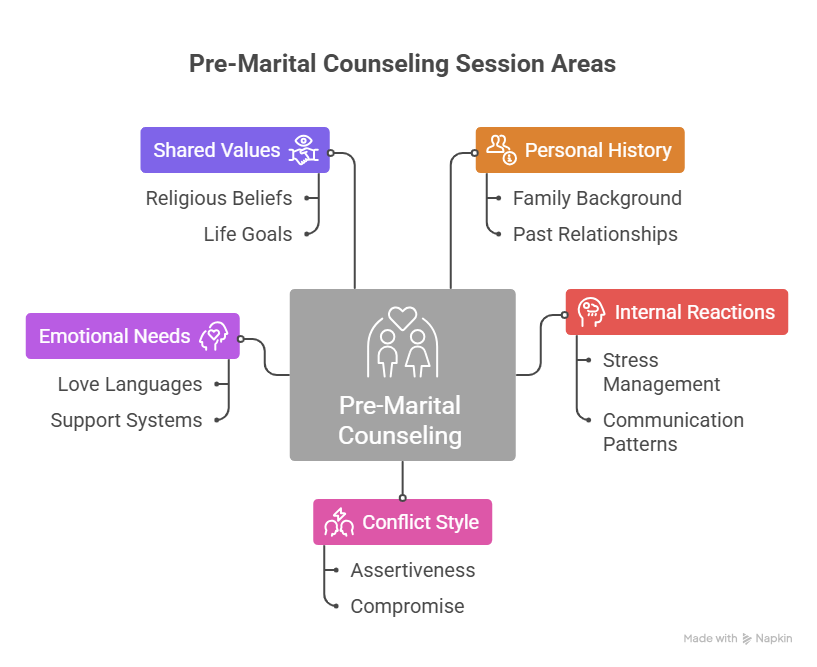
What is Pre-Marital Counseling in Practice?
| Session Area | What We Explore Together |
| Personal history | How your early experiences shaped your relational patterns |
| Internal reactions | Recognizing and naming different parts of yourselves |
| Conflict style | What happens inside each of you during disagreement |
| Emotional needs | What each partner needs to feel safe, seen, and connected |
| Shared values | Areas of genuine alignment and areas worth discussing now |
Why Pre-Marital Counseling Is Not the Same as Couples Therapy
There is a meaningful difference between beginning counseling from a place of crisis and beginning from a place of intentional preparation.
When couples come to me before marriage, there is no accumulated resentment to work through, no protective walls that have hardened over years of feeling misunderstood. There is curiosity, and there is the genuine desire to build something strong.
That said, many of the same IFS principles apply. You can read more about how I approach couples counseling for couples at all stages, including those who are dealing with difficulty alongside preparation.
What makes premarital work particularly meaningful is that the insights you develop now become part of your shared language as a couple. When a difficult moment arises years from now, you will already have the vocabulary and the understanding to navigate it with more compassion.
Beginning Feels Like a Gift You Give Each Other
So, what is pre-marital counseling? There is something quietly generous about choosing to understand each other before the pressures of life make it harder to listen.
Pre-marital counseling is not about identifying problems. It is about choosing depth over assumption and giving your relationship the best possible foundation to build from.
If you are engaged or considering marriage and would like to explore this kind of work, I would love for you to reach out. You can also read about how I approach anxiety and emotional patterns in adults, which often becomes relevant in this work as well.
FAQs
1. What is pre-marital counseling, and who is it for?
It is a structured process for couples preparing to marry, designed to build mutual understanding and address potential patterns before they become problems.
2. Does pre-marital counseling mean there is something wrong with our relationship?
Not at all. Most couples who pursue it describe it as one of the most valuable things they did together, precisely because nothing felt broken when they started.
3. How many sessions does pre-marital counseling typically involve?
This varies depending on what surfaces and how deep each couple wants to go. Some couples complete meaningful work in six to eight sessions. Others continue longer.
4. What if one partner had a difficult childhood with neglect or emotional unavailability?
This is actually an excellent reason to begin premarital work. Understanding those patterns before marriage allows both partners to approach them with compassion rather than confusion.
5. Is pre-marital counseling available online?
Yes. As an IFS therapist licensed in both Maine and New Hampshire, I offer online consultations, making sessions more accessible.
