
When you finally decide to ask for help, one of the first questions you face is whether you need therapy vs counseling. These terms appear interchangeable in everyday conversation, but in clinical practice, they describe meaningfully different experiences.
Choosing between them is not about which sounds more serious. It is about understanding which level of support actually matches what you are carrying.
As a licensed psychologist and certified Internal Family Systems (IFS) therapist in both Maine and New Hampshire, I work with people who arrive at this crossroads regularly.
What I want to offer here is not a textbook definition. I want to help you figure out which path fits your specific situation.
What Each Path Is Actually Designed to Do
Where Counseling Fits
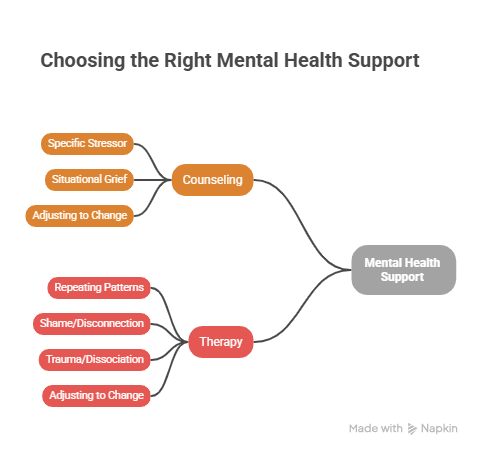
Counseling tends to be present-focused and time-limited. If you are dealing with something identifiable and relatively recent, counseling can offer structure and perspective without requiring you to excavate your entire history. It is useful when:
- You are adjusting to a major life transition, like a career change, divorce, or loss.
- You are experiencing situational grief or stress with a clear origin.
- You want practical coping tools for a specific challenge.
- The difficulty feels contained and has not repeated itself across multiple relationships or contexts.
Where Therapy Goes Deeper
Therapy, by contrast, is appropriate when the difficulty has roots that run deeper than the present moment.
This includes longstanding patterns shaped by early relational experiences, complex trauma, dissociative experiences, or the kind of shame that has quietly directed your choices for years. I work with adults in this territory every day, and what I see consistently is that counseling tools alone do not reach it.
In IFS therapy, we are not managing symptoms. We are exploring the different parts of ourselves that developed in response to adversity, understanding what each part is protecting, and building a relationship between those parts and the calm, compassionate core self. That kind of work requires a specific framework, a skilled clinician, and time.
The Therapy vs Counseling Distinction That Gets Ignored Easily
The Presence of Repeating Patterns
One of the most telling signs that therapy is the right choice is when the same difficulty follows you across different relationships, jobs, or circumstances. You change the external variables, and a version of the same problem reappears.
This is not a coincidence. It is the signature of unresolved internal experience, and it calls for a depth of work that counseling is not designed to provide.
The Weight of Early Experience
Adults who experienced childhood neglect, emotional abandonment, or other forms of early adversity carry internal reactions that feel disproportionate to what is happening in the present moment. A part of them is not responding to the current situation. It is responding to something older.
This is also true for adults working through sexual abuse, complex trauma, or dissociative identity disorder (DID). These presentations require a specialized therapeutic framework, not short-term solution-focused work.
Which One Do You Really Need?
| Your Experience | Better Fit |
| A specific stressor with a clear beginning | Counseling |
| Patterns repeating across different relationships | Therapy |
| Situational grief or life transition | Counseling |
| Shame, disconnection, or numbness lasting years | Therapy |
| Trauma, dissociation, or complex PTSD | Therapy |
| Adjusting to change with moderate distress | Counseling or Therapy depending on depth |
What the Therapeutic Relationship Offers Regardless of the Label
The Foundation That Predicts Outcomes
Whether you pursue therapy vs counseling, decades of research point to the quality of the therapeutic relationship as the most consistent predictor of positive outcomes. In my practice, I hold this as the center of everything else.
Clients who come specifically for IFS therapy share that previous experiences felt clinical or distant. What I offer is something different.
You are not a diagnosis being managed. You are a person whose internal world deserves to be understood with precision and with genuine care. When you feel genuinely met rather than assessed, the work becomes possible in a way it simply cannot be otherwise.
What to Look for When Choosing a Provider
Before you commit to any therapeutic relationship, pay attention to these markers:
- You feel heard, not evaluated, from the first conversation.
- The clinician asks about your experience instead of rushing to categorize it.
- There is no pressure to disclose more than feels safe.
- Your questions are welcome, not deflected.
- You leave the consultation feeling clearer, not more confused.
Considering IFS Therapy Specifically
If you are an adult who has been specifically drawn to internal family systems, that inclination is worth honoring.
IFS is recognized as an evidence-based approach for trauma, PTSD, and complex relational wounds. It offers a way of understanding your internal landscape that most people describe as both precise and deeply humanizing.
As a certified IFS therapist, I offer online therapy sessions to adults who are ready to explore this kind of structured inner work. If you are unsure whether anxiety treatment or depression therapy is your starting point, a consultation can help us figure that out together.
Conclusion
The question of therapy vs counseling is not about choosing the harder path. It is about choosing the right one. If shame, repeating patterns, or experiences of neglect or complex trauma are part of your story, therapy is likely where the real work lives.
As a licensed IFS therapist in Maine and New Hampshire, I invite you to reach out for an online consultation. Together, we can identify what you are carrying and find the support that will actually help you carry it differently.
FAQs
1. Can therapy and counseling overlap in practice?
Yes. A licensed therapist with clinical depth may draw on both approaches depending on what a client needs in a given phase of the work.
2. Is IFS therapy closer to therapy or counseling in its approach?
IFS is a depth-oriented therapy, not short-term counseling. It involves exploring internal parts, early experiences, and longstanding emotional patterns across an extended period of work.
3. Does the provider’s credential level matter when choosing?
It does, especially for complex presentations. A licensed psychologist has doctoral-level training and can assess and treat a broader range of clinical concerns, including trauma and DID.
4. Can I transition from counseling to therapy if I realize I need more?
Absolutely. When figuring out between therapy vs counseling, many people begin with a present-focused approach and recognize, as patterns emerge, that deeper work is what they need. A skilled clinician will recognize this and adjust accordingly.
