

If you have started searching for an IFS therapist near me, you have likely already encountered the term “Internal Family Systems” somewhere, maybe in a podcast, a book, or a recommendation from someone who found real relief through it.
I am Dr. Arlene Brewster, a certified IFS therapist licensed in both Maine and New Hampshire, and I want to give you a specific picture of what this model is, how it works, and what matters when choosing a practitioner.
What Makes Internal Family Systems Different From Other Therapy Models
IFS is built on a premise that feels intuitive once you hear it: you are not one single, unified self. You are made up of multiple internal parts, each with its own perspective, history, and way of trying to help you.
This is the true clinical framework the model rests on, and it shapes every aspect of how a session unfolds.
- Protective parts, sometimes called managers, work to keep your daily life functioning and painful material at a safe distance.
- Firefighter parts react urgently when pain breaks through, often through avoidance, numbing, or impulsive behavior.
- Exile parts carry the original wounds, frequently grief, fear, or shame from earlier experiences.
- Your core Self, which IFS holds as inherently calm, curious, and compassionate, remains accessible beneath all of these parts.
Want to see how this framework applies to real client situations dealing with anxiety? Read more about my approach here.
Why an IFS Therapist Near Me Search Should Go Beyond Certification Alone
Many practitioners list Internal Family Systems as one of several modalities they offer. That is different from a therapist whose practice is built around this approach specifically.
When you are searching for an IFS therapist, it is worth asking how central this model is to their actual clinical work, not just whether they have completed introductory training.
IFS has formal certification levels through the IFS Institute, and a therapist who has pursued advanced training has typically spent years in supervised practice with this model.
That depth shows in how comfortably they help you identify which part is active, how skillfully they help protective parts feel safe enough to step back, and how patiently they work toward unburdening instead of rushing.
How an IFS Session Really Unfolds
Unlike approaches built around discussing a problem analytically, IFS sessions are experiential.
In place of talking about your anxiety in the abstract, I might ask you to notice where it shows up in your body, what it looks or feels like, and what it is afraid would happen if it stepped back. This brings the part into the room as something you can have a relationship with, rather than something happening to you.
Over time, this process allows protective parts to soften because they finally feel understood and not overridden. Once trust builds, exiled parts carrying the original pain can be accessed gently, witnessed, and ultimately unburdened of what they have carried for so long.
The Specific Conditions IFS Therapy Is Especially Suited For
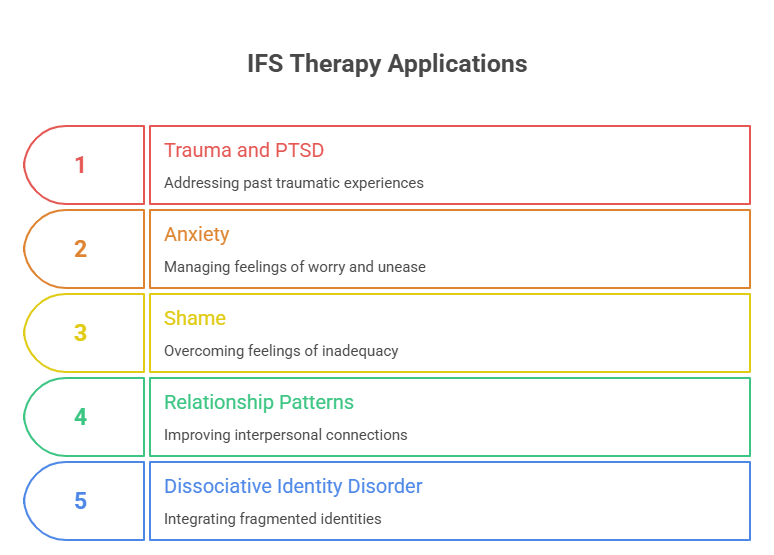
| Presenting Concern | How IFS Specifically Helps |
| Trauma and PTSD | Works with protective parts before approaching the original wound directly |
| Anxiety | Identifies the part generating vigilance and what it is protecting against |
| Shame | Treats shame as something carried by a part, not a fixed truth about you |
| Relationship patterns | Reveals which parts activate during conflict and what they need |
| Dissociative Identity Disorder | Honors each part of a complex internal system with individual care |
An IFS therapist near me who works with this range of presentations understands that the model is not a single technique applied uniformly. It adapts to the complexity of your specific internal system, whether that system is relatively straightforward or deeply layered.
Curious whether IFS is the right fit for what you are carrying? Explore my adult trauma therapy work here.
What Sets Genuine IFS Practice Apart From Borrowed Language
Because IFS terminology like parts work has entered more mainstream use, some practitioners use the language without practicing the model with real fidelity. A few signs distinguish authentic IFS practice from surface-level adoption:
- The therapist asks you to access parts directly in session rather than only discussing them intellectually.
- Protective parts are never forced aside, even when they seem to be blocking progress.
- The pace of the work is set by what your internal system can tolerate, not by a session count.
- Unburdening is treated as a process that unfolds when trust is built, not a goal to push toward quickly.
Accessing an IFS Therapist in Maine or New Hampshire
If you live in Maine or New Hampshire, I offer in-person consultations from my practice. For adults living elsewhere, I offer online consultations with the same depth of IFS-based care.
This model translates fully to a virtual setting, since the work centers on your internal experience instead of anything that requires physical proximity.
I welcome new clients seeking an IFS therapist near me, whether you are local to the Maine or New Hampshire coast.
Ready to begin working with your own internal system? Reach out to me and schedule a consultation today.
FAQs
1. Do I need previous therapy experience before starting IFS sessions?
No, previous therapy experience is not required to begin IFS sessions. Your therapist will guide the process at a pace that feels comfortable and appropriate for you.
2. Do I need to know which part of me is active before starting IFS therapy?
No. Identifying and understanding your parts is part of the work itself. Most people arrive without that language and develop it naturally through sessions.
3. Does IFS therapy focus more on current challenges or past experiences?
IFS therapy can address both present struggles and past experiences depending on your needs. The approach explores how earlier experiences may influence current emotions, behaviors, and patterns.
4. What if I find it difficult to open up during the sessions with an IFS therapist near me?
It is common to feel hesitant or uncomfortable at first, and there is no pressure to share everything immediately. IFS therapy encourages a gradual process that helps build trust and emotional safety over time.
