

When people ask me, “What are some personality traits?” They usually expect a list: outgoing, organized, anxious, easygoing. That list is not wrong, but it tells you very little about why those traits show up the way they do, or why a trait that feels stable in one context seems to disappear entirely in another.
I am Dr. Arlene Brewster, a certified IFS therapist licensed in both Maine and New Hampshire, and I want to offer you a more useful way of understanding personality than a checklist of adjectives.
Why Personality Traits Are Less Fixed Than Most Lists Suggest
Most discussions of personality traits treat them as stable, almost permanent features, the way you might describe your eye color. In practice, traits behave more like patterns that shift depending on context, relationship, and internal state.
A person who is calm and patient at work may become reactive and short-tempered at home, not because their personality changed, but because different parts of them are activated in each setting.
This distinction matters enormously for how you understand yourself. If you have ever wondered why you seem like a different person depending on who you are with, the answer is rarely inconsistency. It is that different internal parts of you take the lead in different contexts, each shaped by different experiences and each carrying its own protective logic.
Curious how these patterns may be showing up in your own life? Learn more about my approach and explore the support options available.
What Are Some Personality Traits That Are Protective Strategies
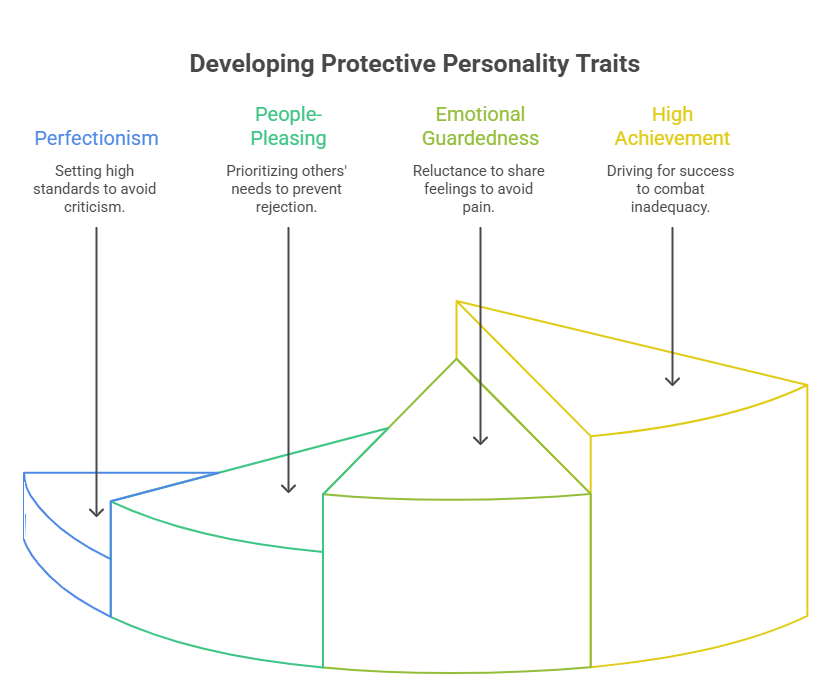
One of the most overlooked angles in personality discussions is how many traits we label as core characteristics developed as protective strategies. A trait is not always who you are at your core. Sometimes it is what a part of you learned to become in order to stay safe.
- Perfectionism develops as a strategy to avoid criticism or rejection, not simply a preference for high standards.
- People-pleasing frequently forms in response to an environment where needs were dismissed, or conflict felt unsafe.
- Emotional guardedness can be a learned response to growing up where vulnerability was met with neglect or ridicule.
- High achievement orientation sometimes masks a part that believes worth must be continually earned.
Understanding this distinction does not mean these traits are problems to eliminate. It means recognizing that some traits are doing a job, and that job deserves curiosity instead of judgment.
Why Some Traits Feel Exhausting to Maintain
If a particular trait feels effortful, not natural, that is a meaningful clue. Traits rooted in genuine temperament tend to feel relatively easy to sustain.
Traits that developed as a survival strategy feel like a performance you have to keep up, because the part responsible for them is working hard, sometimes against your own deeper preferences, to maintain a sense of safety.
How Personality Traits Show Up Differently in Relationships
| Trait | How It Might Show Up With a Partner | What It Could Be Protecting |
| Need for control | Difficulty relaxing decisions to a partner | A part that learned unpredictability was dangerous |
| Avoidance of conflict | Going quiet during disagreements | A part that associates conflict with past harm |
| Constant reassurance-seeking | Frequently checking in about the relationship’s stability | A part shaped by earlier inconsistency or neglect |
| Independence to an extreme | Resistance to being cared for or supported | A part that learned needing others led to disappointment |
This table illustrates something most personality content misses: the trait itself is rarely the full story. What it is protecting explains far more about how to work with it.
Want to explore how your own relational patterns developed? Read more about my couples therapy approach.
Why Shame Shapes Which Traits You Are Willing to Show
Shame plays a significant and underdiscussed role in which personality traits people feel comfortable revealing versus which ones they hide.
Many adults present a more confident or composed version of themselves publicly while privately carrying traits, anxiety, insecurity, and neediness they believe are unacceptable. This is not dishonesty. It reflects a part of you that learned certain traits would not be safely received.
Therapy that genuinely helps with self-understanding does not just ask what are some personality traits you display. It asks which traits you have learned to hide, and what those hidden traits might need in order to feel safe enough to be known.
The Difference Between Core Temperament and Adapted Traits
Some traits are closer to genuine temperament, your natural energy level, sensory sensitivity, or baseline emotional intensity. Others are adaptations layered on top of that temperament in response to your environment.
Distinguishing between the two is genuinely useful, because adapted traits can shift with the right kind of internal work, while temperament-based traits are better understood and accommodated than changed.
Using Personality Insight as a Path Toward Self-Understanding
Asking, “What are some personality traits?” is the beginning of a much deeper question: which of my traits are genuinely me, and which ones developed to protect a part of me that needed safety at some point in my life. That question opens a path toward far more meaningful self-understanding than any trait list alone can offer.
I currently offer online consultations, as well as in-person sessions in the Maine and New Hampshire region, for adults who want to explore these patterns more deeply.
Ready to understand your own patterns more deeply? Get in touch now and book your consultation.
FAQs
1. What are some personality traits that develop from childhood experiences?
Perfectionism, people-pleasing, emotional guardedness, and hyper-independence frequently trace back to early environments where certain traits felt necessary for safety or approval.
2. Can personality traits change over time?
Traits rooted in adaptation can shift meaningfully through therapeutic work, especially when the protective function behind them is understood and addressed directly.
3. Why do I act differently with different people in my life?
This usually reflects different internal parts taking the lead in different contexts, each shaped by different relationships and experiences, rather than inconsistency in who you are.
4. Is it normal to hide certain personality traits from others?
Yes, and it relates to shame about whether those traits will be accepted. Many adults present a more composed version of themselves while privately carrying traits they feel are unacceptable.
5. How can understanding my personality traits improve my relationships?
Recognizing which traits are protective instead of fixed allows you to approach your own reactions with curiosity, which tends to create more understanding and less conflict with the people close to you.
