

When people first hear about Internal Family Systems therapy, they expect the benefits of IFS therapy to look like most other approaches: fewer symptoms, better coping skills, and calmer days. Those outcomes do happen, but they are not really the point.
I am Dr. Arlene Brewster, a certified IFS therapist licensed in both Maine and New Hampshire, and I want to focus on something less discussed: how this model changes your relationship with yourself, which is where mental wellness genuinely begins.
Why Mental Wellness Is About Internal Relationship, Not Just Symptom Reduction
Most measures of mental wellness focus on the absence of distress: lower anxiety scores, fewer depressive symptoms, and better sleep. These matter, but they describe the surface of wellness instead of its foundation.
The benefits of IFS-based counseling extend into a layer symptom-focused measures rarely capture, which is how you relate internally to your own thoughts and emotions.
Wellness, in this model, is less about eliminating difficult internal experiences and more about no longer being at war with them. A person who still feels anxious sometimes but relates to that anxiety with curiosity and compassion is, in a meaningful sense, more well than someone who has suppressed the anxiety but remains internally critical and disconnected from themselves.
Curious what this shift feels like in practice? Learn more about my approach to anxiety.
How Self-Leadership Becomes the Foundation of Lasting Wellness
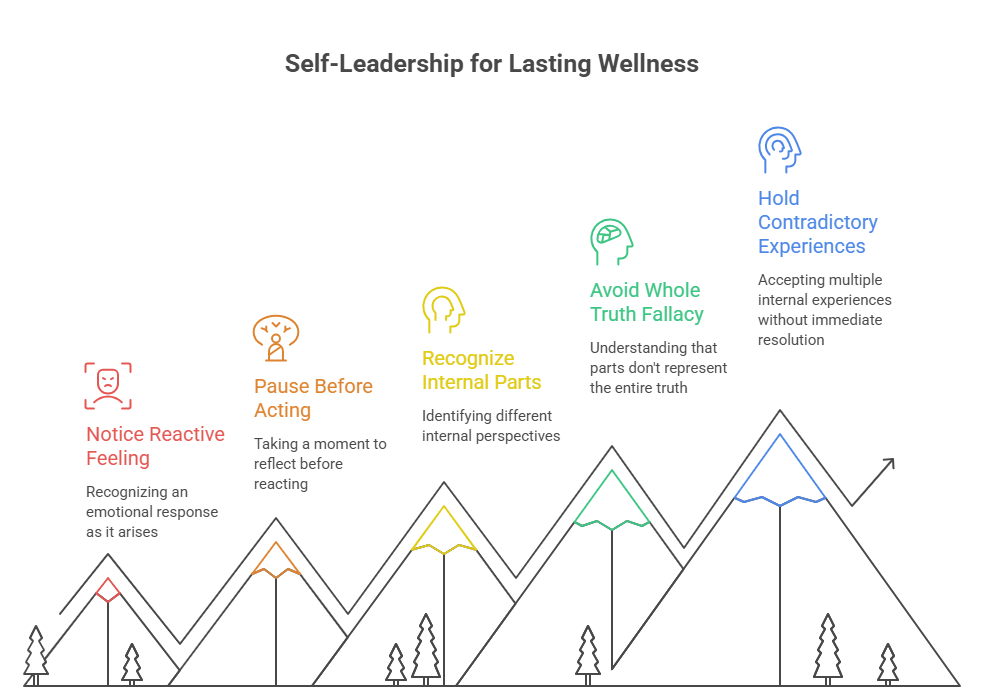
One of the benefits of IFS therapy that receives too little attention is the development of what the model calls “self-leadership,” your capacity to stay grounded in your core self, calm, curious, and clear, even when various parts of you are activated.
Self-leadership is not about controlling or suppressing your parts. It is being able to relate to them from steadiness without being swept along by whichever part is loudest.
- You notice a reactive feeling rising and can pause before it drives your behavior.
- You recognize when a part is speaking rather than experiencing the part’s perspective as the whole truth.
- You can hold multiple, even contradictory, internal experiences without needing to resolve them immediately.
- You approach your own struggles with the same compassion you might offer a friend.
This capacity does not develop through willpower or positive thinking. It develops through the repeated experience of getting to know your own internal system with genuine curiosity, which is exactly what sustained IFS work cultivates over time.
Why Self-Leadership Changes How You Experience Daily Stress
Adults who have developed stronger self-leadership describe daily stress differently than before. The stressful event itself may not change, but the internal experience of it does.
Instead of being entirely taken over by a reactive part, there is a sense of having more internal room, a felt distance between the stress and your core sense of who you are.
The Benefits of IFS Therapy for Long-Term Emotional Regulation
Emotional regulation is taught as a set of techniques: pause, breathe, and reframe. IFS approaches regulation from a different angle entirely.
Rather than teaching you to regulate emotions from the outside, it helps you understand why a particular emotional response activates in the first place, which part is generating it, and what that part needs.
| Traditional Regulation Approach | IFS-Based Regulation |
| Interrupt the emotional response | Understand what the emotional response is protecting |
| Practice calming techniques in the moment | Build a relationship with the part generating the reaction over time |
| Treats intense emotion as something to manage | Treats intense emotion as a part with a legitimate concern |
This distinction matters because regulation that comes from genuine understanding holds up under real stress, while regulation that relies only on in-the-moment techniques can break down when the stress is substantial enough.
Want to explore how this applies to your own patterns? Read more about my adult therapeutic approach here.
How the Benefits of IFS-Based Counseling Extend Into Relationships
The most meaningful long-term benefit of IFS-based therapy is how it changes the quality of your relationships, not by teaching communication scripts but by changing what you bring into the relationship internally.
When you understand your own parts well, you stop unconsciously assigning your reactions to other people. You recognize when your own history is shaping how you are interpreting a situation, which creates space for genuinely different responses.
This shift reduces a specific kind of relational exhaustion many adults carry without naming it: the fatigue of constantly managing internal reactions without understanding where they come from.
When that fatigue lessens, relationships become less effortful in ways that surprise people who have lived with it for years.
Building Mental Wellness That Holds Up Over Time
The benefits of IFS therapy that matter most are not always the quickest ones to appear. Early relief from acute distress is real and worth acknowledging, but the deeper shift, toward genuine self-leadership, internal compassion, and a different relationship with your own reactions, takes place over a longer arc of consistent work. That is also what tends to last.
I currently offer online consultations, as well as in-person sessions for those in the Maine and New Hampshire regions.
Ready to experience these benefits for yourself? Contact me and schedule a consultation.
FAQs
1. What are the most noticeable positive effects of IFS therapy early in treatment?
Many people notice a shift in self-talk early on, becoming less critical and more curious about their own reactions, even before deeper patterns have fully shifted.
2. Can the benefits associated with IFS therapy help with chronic self-criticism?
Yes, significantly. Self-criticism is usually generated by a specific part, and understanding that part softens the harshness of the inner critic over time.
3. Do the benefits of IFS therapy apply to general stress, not just diagnosed conditions?
Yes. Many adults without a specific diagnosis use this work to build a healthier relationship with everyday stress and emotional reactivity.
4. How is mental wellness through IFS different from simply feeling happier?
Wellness in this model is about internal relationships instead of mood alone. You can feel genuinely well even during difficult emotions because the relationship to those emotions has changed.
5. Can IFS therapy improve wellness for adults already in long-term recovery from trauma?
Yes. Many adults who have done deep trauma work find that IFS adds a layer of self-leadership and internal compassion that supports wellness well beyond symptom management.
