

If you have spent years wondering how to stop being codependent, you are probably exhausted in a very specific way.
It is the exhaustion of monitoring someone else’s mood before you can relax, of shrinking your own needs so theirs always come first, of feeling responsible for emotions that were never yours to carry. The good news is that codependency is not a permanent trait. It is a learned pattern, and learned patterns can shift.
I am Dr. Arlene Brewster, a licensed Internal Family Systems (IFS) therapist, and I’m here to help you understand what is driving the pattern so the change has a chance to last.
What Most Advice on How to Stop Being Codependent Gets Wrong
Most articles on this topic jump straight to boundary-setting scripts. Say no more often. Stop fixing other people’s problems. This advice is not wrong, but it treats codependency as a behavior to correct rather than a protective pattern with a much older origin.
Telling yourself to set boundaries without addressing what makes boundaries feel so threatening rarely creates lasting change.
In my work, I see codependency less as a flaw and more as a part of you that learned, usually very early, that your safety or belonging depended on managing someone else’s needs and emotions. That part became skilled at a survival strategy, and it deserves to be understood before it is asked to stand down.
Where This Pattern Usually Begins
Codependent patterns trace back to childhood environments shaped by neglect, inconsistent caregiving, or a household where a parent’s emotional state determined the family’s sense of safety.
If you grew up monitoring a caregiver’s mood or keeping the peace, your nervous system learned that focusing on others was the safest place to put your attention. Recognizing a way to stop being codependent starts with understanding this origin without judging yourself for it.
If childhood neglect or early caregiving wounds feel connected to what you are recognizing in yourself, I invite you to explore the child trauma therapy.
The Internal Parts That Keep Codependent Patterns in Place
The Part That Fears Being Too Much
Many adults working through codependency carry a part that believes their needs, opinions, or emotions are too much for other people to handle. This part formed in response to early experiences where expressing a need led to rejection or dismissal from a caregiver.
As an adult, this part stays quiet, defers constantly, and feels a flood of anxiety at the thought of disappointing someone.
The Part That Equates Self-Worth With Usefulness
A second common pattern involves a part that believes your value depends on what you do for others. This part works tirelessly, often invisibly, to be needed, because being needed feels safer than simply being.
This step in how to stop being codependent requires helping this part discover that your worth does not depend on your usefulness to someone else.
- Notice when you say yes out of fear, and not genuine desire to help.
- Pay attention to the discomfort that arises when someone else handles their own problem without your input.
- Track moments when you feel a surge of relief after being needed, and get curious about what that relief is protecting.
How Internal Family Systems Approaches the Work Differently
Instead of asking you to suppress the part of you that overgives or overmanages, IFS therapy helps you build a relationship with that part from a place of curiosity.
You learn what it fears will happen if it stops working so hard, and you offer it reassurance it has likely never received: that your worth is not conditional, and the relationship in front of you can hold a version of you that has needs too.
This shift tends to be more durable than willpower-based boundary setting, because the part driving the pattern finally feels understood rather than overridden.
A Closer Look at What Shifts Internally Over Time
| Before the Work | As the Pattern Shifts |
| Saying no feels like a threat to the relationship | Saying no feels like an honest, manageable choice |
| Your mood depends on someone else’s emotional state | You can stay grounded even when others are upset |
| Shame surfaces when you prioritize yourself | Self-care feels earned, not selfish |
| You feel responsible for fixing others’ problems | You can offer support without losing yourself in it |
Practical Shifts That Support Lasting Change
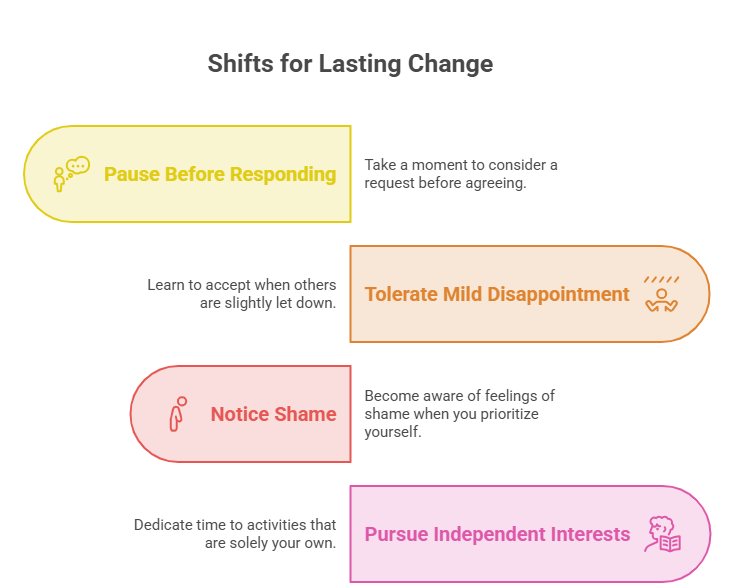
Alongside the deeper internal work, a few daily practices reinforce the shift away from codependent patterns:
- Pause before responding to a request and ask yourself what you actually want, not just what feels safest to offer.
- Practice tolerating someone else’s mild disappointment without immediately trying to fix it.
- Notice when shame shows up after prioritizing your own needs, and remind yourself that this feeling is old, not accurate.
- Spend time on interests or goals that exist independently of anyone else’s approval.
If anxiety shows up alongside these patterns for you, I welcome you to learn more about the approach I take with adults dealing with both.
In Conclusion
Learning how to stop being codependent is not about becoming distant or unkind. It is about discovering that you can care for people without losing yourself in the process.
When the parts of you that have been managing everyone else’s needs finally feel safe enough to rest, relationships tend to become more honest, more mutual, and far less exhausting.
I offer in-person sessions in Maine and New Hampshire only and online sessions to adults who are ready to do this work. If this resonates with you, I invite you to reach out and begin.
You can connect with me anytime to ask questions or schedule a consultation.
FAQs
1. Is codependency the same as simply being a caring person?
No. Caring for others becomes codependent when your own sense of safety, identity, or worth depends entirely on managing their emotions or needs.
2. Can I work on how to stop being codependent without involving my partner in therapy?
Yes. Individual work can create meaningful change in how you relate to others, even if your partner is not currently involved in the process.
3. Does codependency always stem from childhood experiences?
Not always, but it frequently traces back to early relational patterns, including childhood neglect or inconsistent caregiving, even when the connection is not immediately obvious.
4. How long does it typically take to shift codependent patterns?
This varies by individual. Many people notice meaningful internal shifts within several months of consistent IFS therapy, with relational changes following gradually.
