
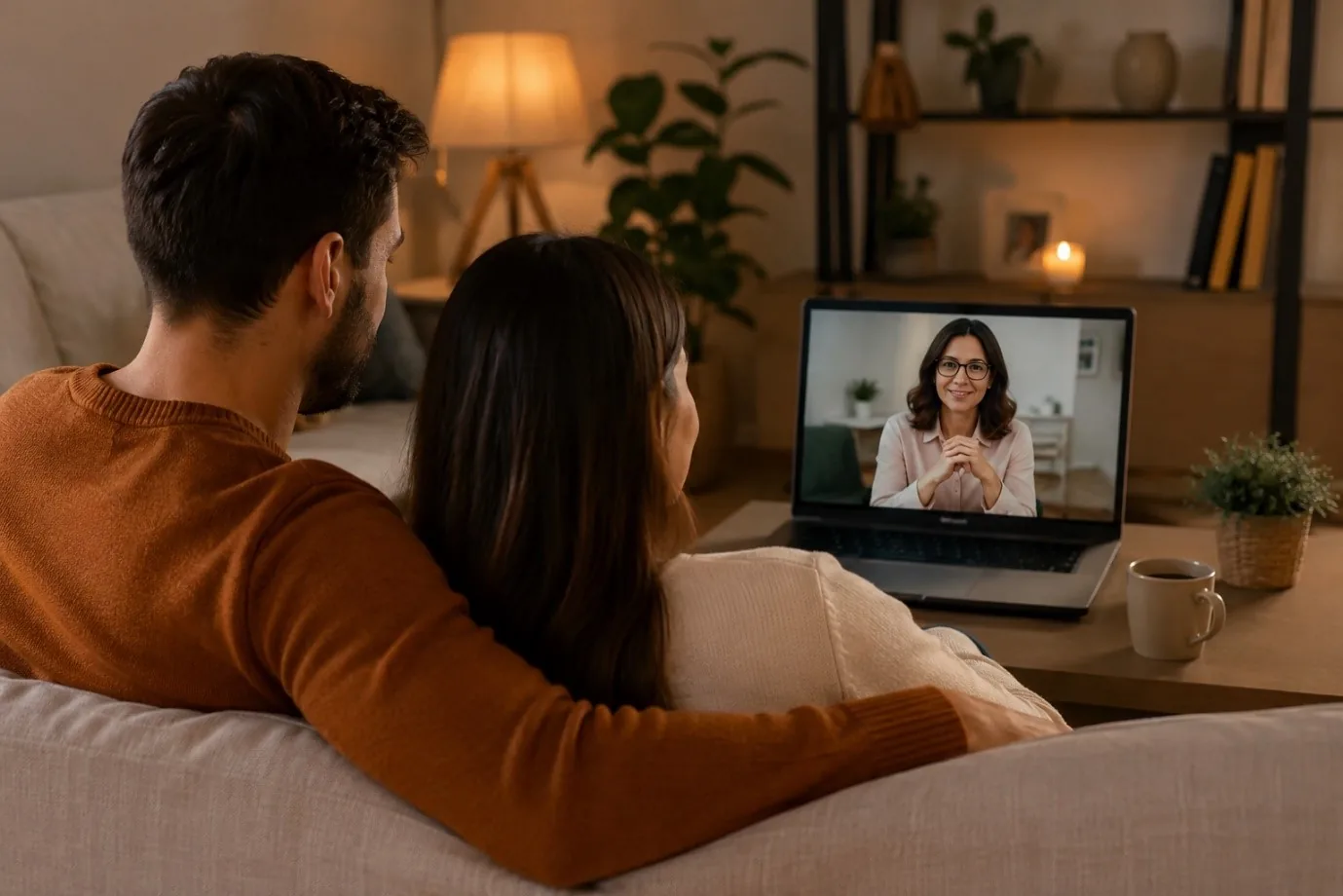
Online relationship counseling raises a specific question that individual therapy does not: What happens when two people, not just one, bring their separate histories and reactions into a virtual room together?
I am Dr. Arlene Brewster, a certified IFS therapist licensed in both Maine and New Hampshire, and I want to walk you through what is unique to couples work specifically, not the general benefits of telehealth you may have already read about elsewhere.
What Changes When Two People Attend a Virtual Session Together
Individual online therapy involves one person and one screen. Online relationship therapy introduces a different dynamic entirely, because both partners are visible to each other and to me simultaneously, often from the same physical space. This creates a specific kind of transparency that some couples find clarifying, and others find initially uncomfortable.
Sitting beside your partner during a session, rather than across from them in an office, can shift the emotional texture of the conversation.
Some couples notice they are more attuned to each other’s micro-reactions, since they are physically close throughout. Others find that shared proximity makes vulnerable moments feel more exposed, since there is no brief walk to the car to decompress separately afterward.
Curious whether this format would work well for your relationship? Find out through my couples therapy approach.
The Specific Question of Where Each Partner Sits During Sessions
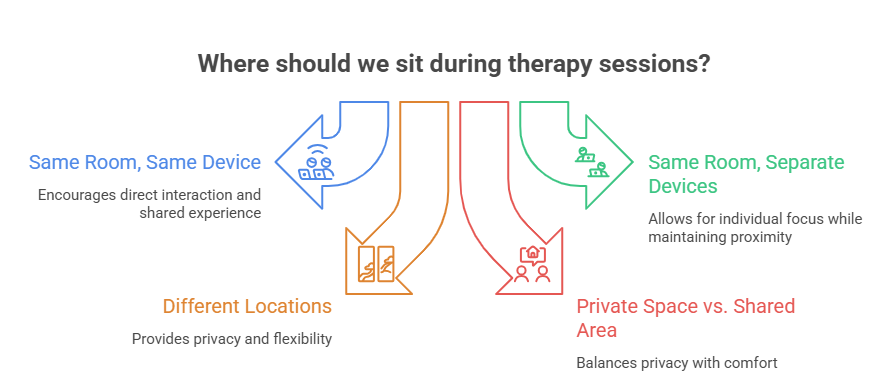
- Same room, same device: Increases shared visibility but can amplify tension if one partner feels physically cornered.
- Same room, separate devices: Gives each partner their own framing and a sense of individual space within a shared session.
- Different locations entirely: Useful for couples who are temporarily apart, traveling, or navigating a trial separation.
- A private space versus a shared living area: Privacy matters more in couples’ work than people anticipate, since difficult material may surface unexpectedly.
This is not typically discussed in general guidance about online relationship therapy, yet it shapes the emotional safety of a session as much as the content discussed within it.
How Online Relationship Counseling Handles Moments of High Conflict
A question I hear frequently is what happens if a session becomes heated while both partners are on a screen rather than in a room with a therapist physically present.
In practice, the dynamics of de-escalation translate well to video, though they require some intentional adjustment.
| In-Person Session | Virtual Relationship Counseling |
| Therapist can shift physical proximity to de-escalate | The therapist uses verbal pacing and direct naming of the moment |
| Shared physical space naturally slows reactive movement | A brief pause or muting practice can create a similar space |
| Walking to separate cars after a hard session | Partners may need a deliberate transition ritual before re-entering daily life |
I work with couples to build a short transition practice for after sessions, since stepping immediately from a vulnerable conversation into the rest of a shared evening can leave unprocessed intensity lingering in the room.
Want to know how I support couples through difficult sessions? Explore my approach to trauma-informed care.
Why Online Relationship Counseling Can Reveal Patterns In-Person Sessions Miss
There is a specific advantage to virtual relationship counseling that rarely gets named: I can sometimes see relational dynamics more clearly through a screen than I would in an office.
When couples join from home, their natural environment and unscripted interactions before and after the session, like settling in, adjusting the camera, and a quick exchange about logistics, offer small but genuine glimpses into how they relate day-to-day.
These unguarded moments are not something I seek out deliberately, but they provide useful context that an office setting, with its built-in formality, does not naturally produce.
Building Consistency Into Online Relationship Therapy Over Time
One of the more practical and underdiscussed aspects of sustained virtual relationship counseling is how it supports consistency through life’s ordinary disruptions.
A sick child, a late work meeting, or a minor schedule conflict that might cancel an in-person appointment entirely still allows a session to happen virtually, even if one partner needs to step into another room briefly. This consistency matters more than it might initially seem, since momentum in couples’ work is genuinely difficult to rebuild after repeated gaps.
I currently offer online consultations, alongside in-person sessions in Maine and New Hampshire through my couples’ therapy practice.
Taking the Next Step Toward a Stronger Connection
Online relationship counseling is not just in-person therapy moved onto a screen. It carries its own specific dynamics, from where you sit to how shame surfaces to the unscripted glimpses of daily life that deepen the work in ways couples do not expect.
If you are ready to explore what this kind of counseling could offer your relationship, I welcome you to reach out.
Ready to begin working on your relationship together? Reach out today and schedule a consultation.
FAQs
1. Should both partners use the same device for online relationship therapy?
It depends on the couple. Some prefer shared visibility on one screen, while others find separate devices give each partner a clearer sense of individual space within the session.
2. Can virtual relationship counseling work if we are in different locations?
Yes. This is one of its specific advantages, allowing couples navigating travel, deployment, or temporary separation to maintain consistent relational work.
3. What happens if conflict escalates during an online session?
I use verbal pacing and direct naming of the moment to create space, similar to what physical proximity offers in an office, and suggest a brief pause if needed.
4. Does meeting from home make vulnerable topics harder to discuss?
It varies by couple. Some feel safer at home, while others associate the space with past conflict, which can make certain topics feel more charged.
5. How does online relationship counseling support consistency over time?
It allows sessions to continue through minor disruptions like illness or scheduling conflicts that might otherwise cancel an in-person appointment, preserving momentum in the work.
