

Does insurance cover therapy? It is one of the first practical questions you probably have before you even start looking for the right clinician, and it deserves a clear answer rather than vague reassurance.
The truth is that coverage depends on several specific factors, and understanding them ahead of time can save you from confusion or unexpected bills.
I am a licensed psychologist and certified Internal Family Systems (IFS) therapist serving in Maine and New Hampshire. I want to walk you through what insurance coverage for therapy seems like, including details that most general explanations skip entirely.
The Question Behind “Does Insurance Cover Therapy?” That Nobody Asks First
Most people ask if insurance covers therapy as though it has one universal answer. It does not. The answer depends heavily on whether your provider is in-network or out-of-network with your specific plan, and these two paths lead to very different financial experiences.
- In-network providers have a negotiated price with your insurance company, so your portion is typically a fixed copay.
- Out-of-network providers may still be reimbursable, but you usually pay the full session fee upfront and submit a claim afterward.
- Reimbursement rates for out-of-network care vary significantly and are rarely the full session cost.
- Some plans have no out-of-network mental health benefit at all, which is worth confirming before your first session.
Why Specialized Therapy Sometimes Complicates Coverage
If you are looking for a specific therapeutic approach, such as Internal Family Systems therapy, your insurance may cover the session under a general mental health code regardless of the modality used.
However, if your plan requires prior authorization for certain diagnoses, including complex trauma or Dissociative Identity Disorder (DID), the approval process can take longer than a typical referral.
If you are navigating complex trauma and want to understand whether IFS therapy might be the right fit before involving insurance questions, I invite you to explore my trauma therapy first.
What Decides Whether Your Specific Plan Will Pay
Insurance reimbursement is typically tied to a diagnosis code, not just the fact that you attended a session. This means your therapist usually needs to document a qualifying diagnosis, such as an anxiety disorder, depressive disorder, or post-traumatic stress disorder, for the claim to process.
If your primary concern is something like ongoing shame, relationship patterns, or the lingering effects of childhood neglect that have not yet crystallized into a formal diagnosis, coverage can sometimes become murkier. It is worth asking how a potential diagnosis might be approached before your first session.
Session Limits and Why They Catch People Off Guard
Many plans cap the number of covered therapy sessions per year, and these caps are not always clearly communicated upfront.
If you are entering longer-term work, such as IFS therapy for complex trauma or longstanding relational wounds, it is worth knowing this ahead of time and not discovering it mid-treatment.
- Some plans cap sessions at a set number per calendar year.
- Caps may reset annually, but not retroactively if you switch plans mid-year.
- Couples therapy and individual therapy may be billed and capped differently under the same plan.
- Telehealth sessions are sometimes covered differently than in-person sessions, depending on the insurer.
A Clearer Overview of How Coverage Plays Out
Here is a simplified comparison of how the most common payment paths typically work, so you can ask more informed questions when you call your insurer.
| Payment Path | What You Can Expect |
| In-network insurance | Fixed copay per session, set by your specific plan |
| Out-of-network insurance | You pay upfront, then submit for partial reimbursement |
| Private pay (self-pay) | You pay the full session fee directly, with no insurance involvement |
| Health Savings Account (HSA) | Often usable for therapy costs, but confirm eligibility with your plan |
Questions Worth Asking Your Insurer Directly
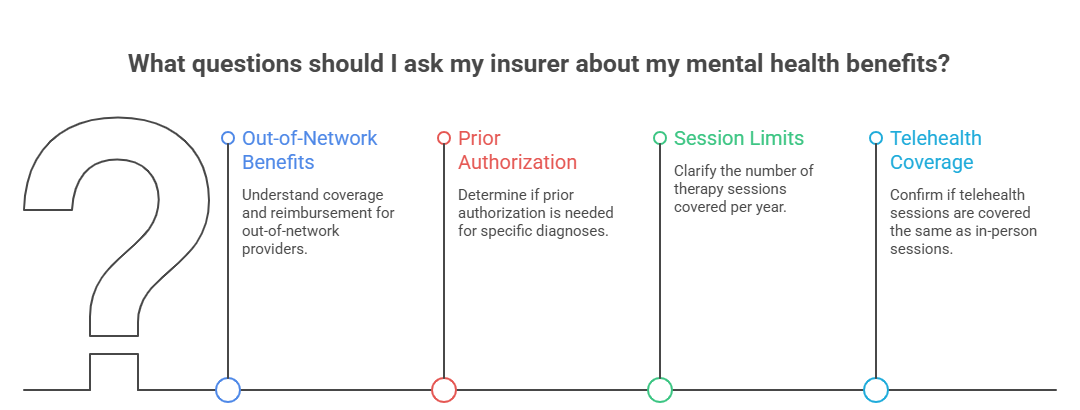
Before you assume the answer to “Does insurance cover therapy?” is simply yes or no, call your insurance provider and ask these important questions:
- Do I have out-of-network mental health benefits, and what is the reimbursement percentage?
- Is prior authorization required for any of my potential diagnoses?
- How many therapy sessions are included per calendar year under my plan?
- Are telehealth sessions covered the same way as in-person sessions?
Why I Encourage You to Ask Rather Than Assume
I understand that calling an insurance company can feel like one more obstacle between you and the support you need. But avoiding that conversation costs more in the long run, both financially and emotionally.
I would rather you have a clear, accurate answer before you start than discover a surprise bill after several sessions. If you reach out for a consultation, I am happy to talk through what payment options look like so you can make an informed decision.
If anxiety or depression has been part of what is bringing you to this question, I would like you to learn more about the approach I take with adults handling these experiences.
To Conclude
Does insurance cover therapy? In most cases, yes, but the specifics depend on your plan, your provider’s network status, your diagnosis, and the structure of your particular benefits.
Taking the time to ask the right questions before your first session can spare you confusion later and let you focus fully on the work itself.
I offer online sessions and in-person consultations in Maine and New Hampshire. If you have questions about how payment might work for your specific situation, connect with me directly.
FAQs
1. Does insurance cover therapy for online sessions specifically?
Many plans now cover telehealth therapy similarly to in-person sessions, but this varies by insurer. It is worth confirming directly with your plan before your first online session.
2. Will my insurance know what kind of therapy I am receiving, such as IFS?
Insurance claims are typically tied to a diagnosis code instead of a specific therapeutic modality, so the type of therapy used is usually not a factor in coverage decisions.
3. What happens if my plan does not cover therapy at all?
If coverage is unavailable, private pay is still an option, and some practices offer different fee structures. It is worth asking directly about what arrangements might work for your situation.
4. Can I make use of my HSA or FSA for therapy sessions?
Typically, yes. Health Savings Accounts and Flexible Spending Accounts mostly cover mental health services, though it is worth confirming eligibility with your specific account provider.
