

If you and your partner keep having the same argument in different clothing, trauma-informed couples therapy may be the missing piece you have not tried yet.
Most couples work focuses on communication skills and compromise. What it misses is the deeper layer underneath your conflict, the parts of each of you that learned, long before this relationship began, how to protect yourselves from pain.
I am Dr. Arlene Brewster, a licensed Internal Family Systems (IFS) therapist serving in Maine and New Hampshire. I want to help you understand what trauma-informed couples counseling looks like and why it reaches places other approaches cannot.
What Makes a Couple’s Approach Genuinely Trauma-Informed
A common misconception is that trauma-informed therapy simply means the therapist is careful and kind. Kindness matters, but it is not the defining feature.
A genuinely trauma-informed approach recognizes that each partner brings an internal system shaped by earlier experiences, and that your reactions to each other are rarely just about the present moment.
In my work, this means understanding that when your partner shuts down during a hard conversation, or you feel a wave of panic at the first sign of distance, those responses trace back to earlier relational wounds, including childhood neglect or emotional abandonment your partner may have never fully named even to themselves.
Recognizing When Conflict Is a Trauma Response
One of the clearest signs that trauma-informed couples therapy is the right path is when conflict patterns feel wildly disproportionate to the issue at hand. You might notice:
- A small disagreement spirals into a much larger emotional crisis within minutes.
- One partner goes completely silent or seems to disappear emotionally during conflict.
- Reassurance never seems to land, no matter how many times it is offered.
- Old arguments resurface almost word for word, regardless of how much has changed.
How Internal Family Systems Changes the Conversation Between You
Most couples’ approaches teach new communication scripts. This work does something different. It helps each of you identify the specific parts of yourself that activate during conflict, understand what those parts are protecting, and learn to speak from a grounded place rather than from the most reactive part in the moment.
A part of you might criticize your partner the moment you feel unseen, because criticizing feels safer than admitting how much their attention matters to you. A part of your partner might withdraw the instant a request feels like criticism, because withdrawal once kept them safe from a parent who reacted with anger.
Naming these parts together, with curiosity, not blame, changes the entire emotional climate of the relationship.
Why This Is Important for Couples With Trauma Histories
If you or your partner are carrying experiences of abuse, neglect, sexual trauma, or dissociative experiences, including Dissociative Identity Disorder (DID), generic couples counseling can sometimes do more harm than good.
Without a trauma-informed lens, well-meaning techniques can inadvertently re-trigger old wounds or ask a partner to be vulnerable before their internal system feels safe enough to do so.
If sexual trauma history is part of your story and you want a therapeutic approach built around that reality, I invite you to explore the therapy work.
The Specific Relational Patterns Trauma-Informed Couples Therapy Addresses
Shame hardly announces itself directly in a relationship. It shows up as defensiveness, as over-explaining, or as a partner who cannot tolerate being told they made a mistake.
This work makes room for shame to be named and understood through well-intentioned but unaware interactions.
When you can recognize that your partner’s defensiveness is shame in disguise, and they can recognize the same in you, something shifts. You stop taking the reaction personally and start responding to what is happening underneath it.
What Can You Expect From the Process
This work moves at a pace that honors both partners’ capacity to stay present. That sometimes means slowing down a conversation that would otherwise escalate or naming when a part has taken over before continuing.
The goal is never to force vulnerability. It is to build enough internal safety that vulnerability becomes possible.
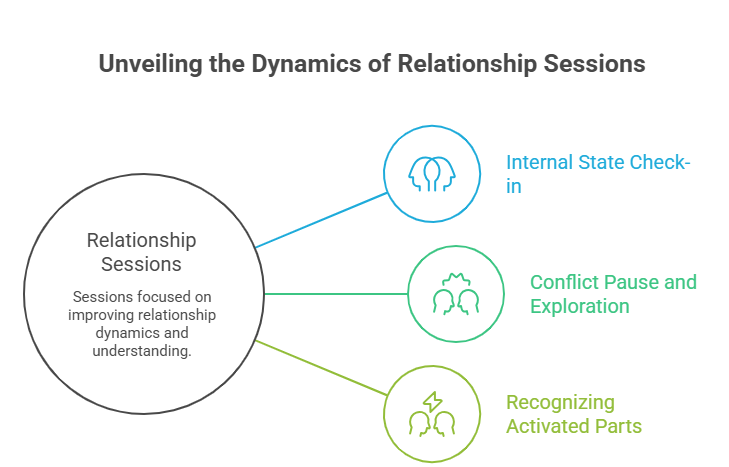
- Sessions begin with checking in on each partner’s internal state, not just the week’s events.
- Conflict in the session is paused and explored rather than allowed to run its usual course.
- Both partners learn to recognize their own activated parts before reacting to each other.
- Repair is treated as a skill to practice, not a moment that either happens or does not.
If you are ready to explore this kind of work together, I welcome you to reach out for an online consultation.
Last Word
This kind of work is not about assigning blame for old wounds or relitigating the past every session. It is about understanding why you and your partner react the way you do, so those reactions stop running the relationship from the shadows.
When both of you can meet each other’s protective parts with curiosity instead of frustration, a real connection becomes possible again.
I offer in-person sessions in Maine and New Hampshire, along with online sessions. If old patterns have been quietly shaping your relationship for longer than you would like to admit, I encourage you to get in touch and begin this work together.
You can also learn more about how I work with individuals carrying depression and emotional overwhelm if one or both of you are navigating that alongside the relationship.
FAQs
1. Is trauma-informed couples therapy only for couples with a history of abuse?
No. It benefits any couple whose conflict patterns seem disproportionate to the present, even without a clear history of abuse. Childhood neglect or subtle emotional wounds can shape adult relationships just as powerfully.
2. How is this different from standard couples counseling?
Standard counseling teaches communication tools without addressing why those tools fail to land. Trauma-informed couples therapy explores the deeper internal patterns driving disconnection before introducing new skills.
3. Can one partner benefit even if the other is hesitant to start?
Yes. Individual work using the same trauma-informed framework can still create meaningful change in the relationship and sometimes opens the door for a partner to join later.
4. Is this approach helpful if one partner has dissociative identity disorder?
Yes. A trauma-informed lens allows the work to move at a pace that respects a complex internal system, instead of pushing for vulnerability before it feels safe.
