

When you decide to reach out for mental health support, one of the first questions that quietly surfaces is this: what is the difference between a psychologist vs. therapist, and which one do you actually need?
It deserves a thoughtful answer instead of a comparison chart. The distinction matters, but not always in the ways most people assume, and understanding it can help you move toward the right support with confidence.
What I want to offer in this blog is not a resume comparison. I want to help you understand what these roles mean in practice, so you can choose care that fits you.
The Part of This Question Most Articles Skip
Most content on this topic stops at education and licensing. You have probably already read that psychologists hold doctoral degrees and therapists may hold master’s degrees. What rarely gets addressed is what that means for the work you do together once you are in the room.
A psychologist with doctoral-level training has completed extensive supervised clinical hours and passed national and state licensing exams, which gives them the depth to assess and treat a broad range of presentations. This matters most when you are navigating something complex or not easily categorized.
When Specialization Matters More Than the Title
The more useful question is not psychologist vs. therapist, but what this specific clinician specializes in and whether that matches what you are carrying.
A therapist with advanced training in a specific modality may offer something more targeted than a generalist psychologist, while a psychologist specializing in trauma or IFS brings both breadth and depth to complex relational wounds.
If you are an adult dealing with trauma, shame, or longstanding internal patterns, I invite you to learn more about the IFS approach I use in my work through my trauma therapy.
What the Title Cannot Tell You About Fit
When you ask about the difference between a psychologist and therapist, you are usually asking something more personal. You want to know whether this person will understand what you are carrying, whether you will feel safe, and whether the work will reach the part of you that has been struggling for a long time.
A credential comparison alone cannot answer that. It gets answered in the texture of a first conversation, in whether you feel met, not evaluated, and in whether the clinician holds your complexity without rushing to categorize it.
Markers of Genuine Clinical Fit
Before committing to any clinician, pay attention to these markers:
- You feel heard in a first consultation, not processed.
- Your questions are welcomed without being deflected.
- The clinician speaks about your experience with curiosity rather than certainty.
- You are not pressured to disclose more than feels safe.
- The framework they use is clearly explained and makes sense to you.
- You leave the initial conversation feeling clearer, not more uncertain.
How Training Differences Show Up in the Room
Here is a comparison that moves past the usual education chart into what shows up in clinical practice.
| Clinical Element | Master’s-Level Therapist | Doctoral-Level Psychologist |
| Psychological assessment | Limited or referred out | Can conduct and interpret directly |
| Complexity of presentations | Situational to moderate | Moderate to highly complex |
| Dissociative presentations (DID) | Varies significantly | Greater depth to assess and treat |
| Trauma-focused depth | Depends on specialization | Broader diagnostic and treatment scope |
I work with adults who have spent years in support that reached so far and no further. IFS therapy offers a way into the internal structure of what you are carrying, not just its surface.
If anxiety or depression have been persistent companions in your life and you are wondering whether a different kind of support might finally reach them, I encourage you to explore the approach I take on my anxiety treatment.
The Role an IFS-Certified Psychologist Plays in This Conversation
When you search for the difference between a psychologist vs. therapist, you are usually thinking about credentials. I want you to consider the therapeutic framework just as closely, because the framework determines what kind of healing is possible in the work.
Internal Family Systems (IFS) therapy understands the mind as containing different parts of ourselves, each with its own history and protective role. This is not a metaphor. It is a precise, structured way of understanding the internal reactions that have been quietly driving your behavior, your relationships, and your sense of self.
Who Benefits Most from This Approach
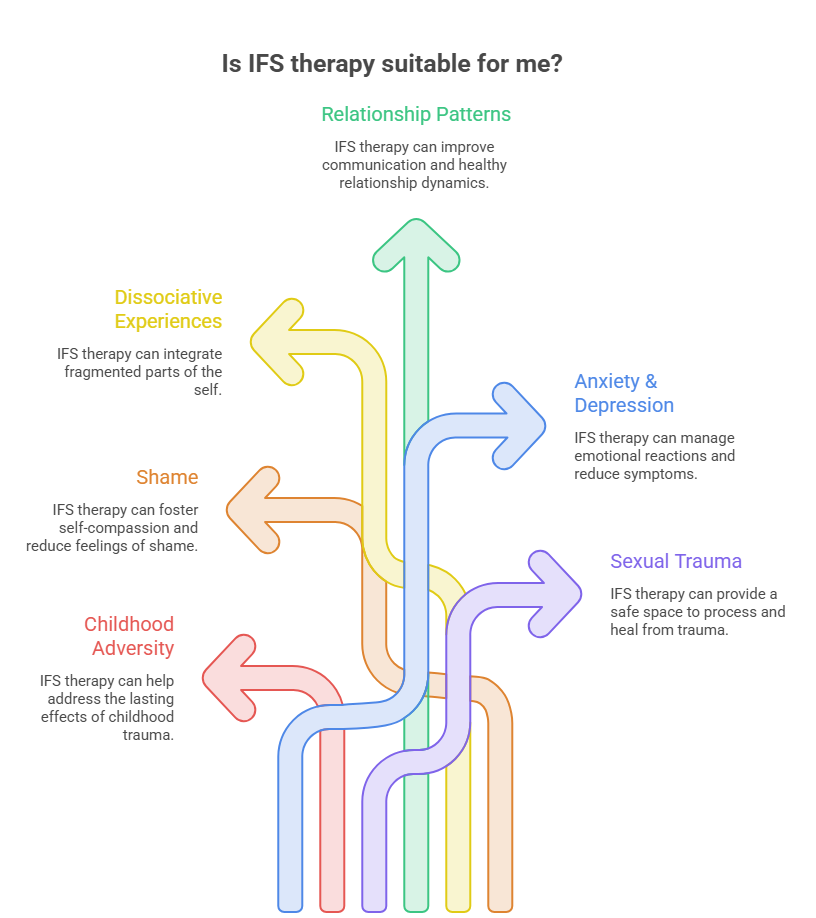
IFS therapy is particularly meaningful for adults facing:
- Childhood adversity, including neglect, emotional abandonment, or abuse.
- Shame that has quietly shaped your choices for years.
- Dissociative experiences, including Dissociative Identity Disorder (DID).
- Relationship patterns that repeat despite genuine effort to change them.
- Anxiety, depression, and emotional reactions that feel disproportionate to the moment.
- Sexual trauma and the lasting internal weight of violation.
If you are an adult living in Maine or New Hampshire and are ready to explore what this kind of work might offer you, I welcome you to reach out for an online consultation.
Conclusion
The question of psychologist vs. therapist is genuinely worth understanding, but it is the beginning of the conversation, not the whole of it. What matters most is whether the clinician you choose has the depth, the framework, and the relational presence to meet what you are really carrying.
As a licensed psychologist and certified IFS therapist, I bring doctoral-level clinical depth and a specialized framework for working with the parts of you that have been quietly driving the struggle. All sessions are offered online. Only those living in Maine and New Hampshire can visit me in person.
Schedule your session today!
FAQs
1. Can a psychologist also be trained in IFS therapy?
Yes. A psychologist can hold IFS certification alongside doctoral licensure. Dr. Brewster is both a licensed psychologist and a certified IFS therapist, bringing both levels of training to the work.
2. Is online therapy with a psychologist as effective as in-person sessions?
Research consistently supports online therapy as effective for a broad range of presentations. Dr. Brewster offers online sessions to adults across Kittery Point, Maine, and Portsmouth, New Hampshire.
3. Do I need a referral to see a psychologist for therapy?
In most cases, you do not need a referral to begin working with a licensed psychologist directly. An initial consultation is generally the starting point.
4. How do I know if IFS therapy is the right fit when choosing between a psychologist vs. therapist?
If your concerns involve longstanding internal patterns, shame, trauma, or complex emotional experiences, including dissociation, IFS therapy with a certified and doctorally trained clinician is likely a strong match.
