
If you have never been to therapy before, or if previous experiences left you uncertain about what to expect, it is completely natural to wonder: how does couples counseling work, and will it actually be useful for what we are going through?
The idea of sitting with your partner in front of a therapist can feel exposing or even a little daunting. I want to demystify that experience.
I am a certified IFS therapist licensed in both Maine and New Hampshire, and my approach is built around making therapy a genuinely safe space for both of you, not a place where one person is assessed or another is blamed.
What Most Couples Are Not Told Before the First Session
Most articles about couples counseling jump straight to describing what happens in the room. But there is something worth addressing before that: the conversation most couples have the night before their first session.
Usually, at least one partner arrives with a private worry. They wonder whether the therapist will take sides, whether their own behavior will be examined in ways that feel unfair, or whether what they share will somehow be used against them.
These are real concerns, and they come from protective parts of you that have learned to be cautious about vulnerability.
I want to say clearly that my role is not to adjudicate. My role is to help both of you understand what is happening inside each of you during the moments that cause the most pain between you. That is a very different thing from deciding who is right.
How Does Couples Counseling Work When Both Partners Have Different Goals
It is more common than you might think for couples to arrive with different ideas about what they are hoping to get out of the process.
One partner may want to save the relationship. The other may be less certain about that goal but willing to explore. One may want to be heard. The other may want their partner to change.
In my experience, these different starting points are not obstacles. They are part of what we work with. The first conversations I have with couples are designed not to align your goals artificially but to understand what each of you is actually carrying when you walk through the door.
- What does each partner hope to experience differently in the relationship?
- What parts of each person feel most protective or guarded right now?
- What does each of you need to feel safe enough to be honest?
- Whether either partner is carrying shame about the current state of things.
The Internal Process That Happens Alongside the Conversation
One of the things that distinguishes IFS-informed couples’ work from general talk therapy is attention to what is happening inside each person, not only what is being said between them.
When you notice a part of yourself tensing as your partner speaks, or a part that wants to withdraw or defend, those internal reactions are not interruptions to the therapy. They are the therapy.
I help both of you slow down enough to notice those reactions, name them, and understand what they are actually trying to protect. This is what makes it possible to move from a reactive dynamic to something that feels more genuinely connected.
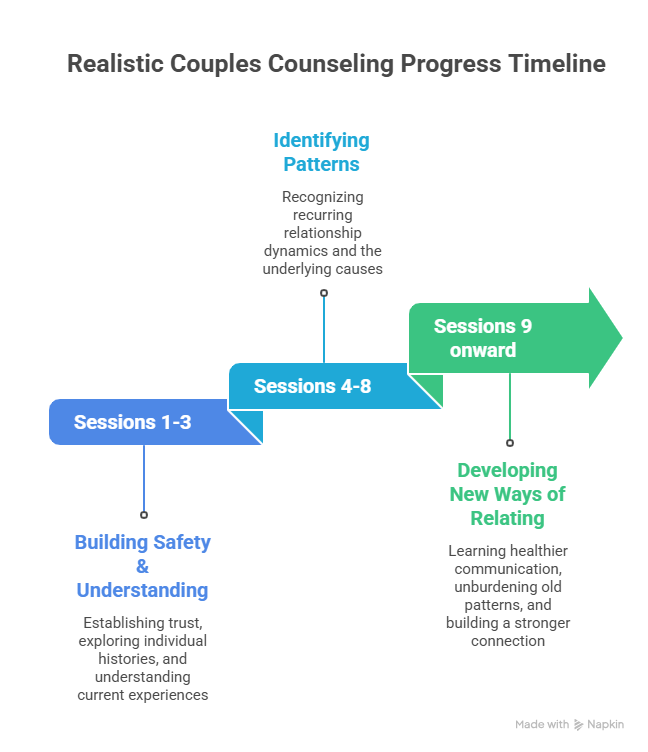
A Realistic Progress Timeline of How Does Couples Counseling Work
| Stage of Work | What Typically Happens |
| Sessions 1 – 3 | Building safety; understanding each partner’s history and current experience |
| Sessions 4 – 8 | Identifying recurring patterns and the parts driving them |
| Sessions 9 onward | Developing new ways of relating; unburdening long-held patterns |
Progress in couples counseling is rarely linear. There will be sessions that feel like breakthroughs and sessions that feel more like consolidation. Both are part of the work.
What I ask of both partners is a willingness to stay curious about themselves, even when it is uncomfortable.
What Happens When One Partner Had a Difficult History
A huge number of couples come to me where one or both partners carry the effects of difficult childhood experiences, including neglect, emotional unavailability, or early relational trauma.
For many people wondering how does couples counseling work, part of the process involves understanding how these histories shape the way each person interprets their partner’s behavior. Ordinary moments of disconnection can begin to feel catastrophically familiar.
My background in childhood trauma therapy means I understand how these early experiences live in the body and in the parts of a person, and I bring that same care into the couples’ work.
When one partner’s history is particularly significant, I may suggest that individual sessions run alongside the couple’s work. This is not about giving one person more attention. It is about ensuring both partners have the support they need to show up fully for each other.
Practical Aspects of Sessions With Me
I offer online consultations for adults in Maine and New Hampshire. All sessions are conducted via a safe and secure video platform, which many couples find actually reduces some of the anxiety of the first meeting. You are in your own space, which can feel easier.
If you are curious about what the process might look like for your specific situation, I welcome you to explore more about how I approach couples therapy and reach out with any questions.
FAQs
1. How does couples counseling work if we disagree about whether therapy is the right step?
That uncertainty is worth bringing to the first session directly. I work with ambivalence rather than around it, and it rarely needs to be resolved before starting.
2. Will the therapist give us homework or exercises between sessions?
Sometimes I offer gentle practices for between sessions, but the work is never about performance. It is about what you notice and feel willing to explore.
3. What if one partner becomes upset or distressed during a session?
This is a normal part of the work. I create a steady, calm environment and help each partner move through difficult moments with care rather than avoidance.
4. How long are sessions, and how regularly do we meet?
Sessions are typically fifty minutes. Most couples begin with weekly sessions and adjust frequency as the work develops.
5. Can couples counseling address individual issues like anxiety or shame?
Yes, and in many cases it must. Anxiety and shame frequently drive relational patterns, and understanding them individually makes the couple’s work more effective.
