
Separation does not always mean the end of a relationship, and it does not always mean both partners have stopped caring.
For many couples, it marks a moment of genuine crisis: a point where the familiar patterns become too painful to continue, and distance feels like the only available relief.
If you and your partner are living apart and wondering whether something between you can still be repaired, marriage counseling for separated couples may offer a path you have not yet fully considered.
I am Dr. Arlene Brewster, a certified IFS therapist licensed in both Maine and New Hampshire, and I work with couples who are willing to look honestly at what happened between them.
Why Separation Can Create a Window for Honest Work
Most couples reach separation after months or years of repeated conflict, withdrawal, or disconnection. The distance that comes with living apart, while painful, sometimes creates something that was missing during the marriage itself: enough space to actually feel what is happening inside you, instead of only reacting to your partner.
When you are no longer experiencing the daily friction of a shared household, it can become clearer which of your reactions belong to the present and which have deeper roots.
A part of you that becomes withdrawn when criticized may be protecting a much older wound. A part that pursues and pushes for connection may be driven by early experiences of abandonment rather than by anything your partner actually did this week.
This is the kind of work that marriage counseling for separated couples, approached through an IFS lens, makes possible. Not just better communication scripts, but a genuine understanding of the internal reactions driving the patterns that wore the relationship down.
What Separated Couples Often Get Wrong About Reconciliation
One of the most common assumptions I encounter is that reconciliation means returning to the relationship as it was. That assumption is part of why so many attempts at reuniting fail.
If you go back to the same dynamic without understanding what was driving it, you go back to the same pain on a slightly delayed timeline.
What actually makes reconciliation meaningful is a shift in how each partner relates to their own internal world. When you can recognize a protective part of yourself that shuts down under pressure, and when your partner can recognize the part of themselves that reads that shutdown as rejection, something genuinely different becomes possible between you.
- Each partner gains clarity about their own patterns, not just their partner’s.
- Protective reactions are understood rather than dismissed or escalated.
- Shame around the separation itself is addressed with care.
- Both partners develop the capacity to return to their core Self in moments of tension.
When One Partner Wants to Reconcile, and the Other Is Uncertain
This is one of the most difficult situations I work with in marriage counseling for separated couples. One person may feel ready to move toward repair while the other is still protecting themselves from further hurt. In this scenario, the uncertainty itself is not a problem to be solved quickly. It is information.
The partner who is uncertain may have a protective part that is very reasonably cautious. Forcing reconciliation without respecting that part rarely leads to lasting change.
What I do is help both partners understand what each of their parts is actually asking for and whether those needs can genuinely be met within the relationship.
How Sessions Are Structured for Couples Who Are
Because I offer online consultations for adults, location is not always a barrier to beginning this work.
Separated couples can attend sessions from their respective homes, which also removes some of the logistical tension that comes with coordinating schedules around shared spaces.
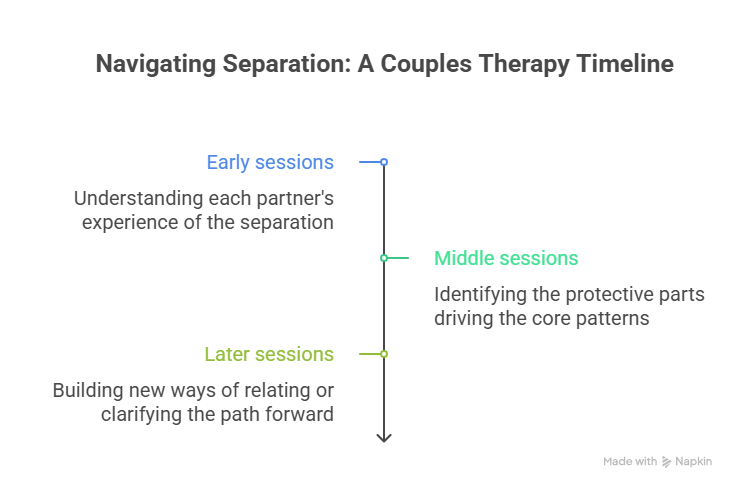
| Session Focus | What We Explore |
| Early sessions | Understanding each partner’s experience of the separation |
| Middle sessions | Identifying the protective parts driving the core patterns |
| Later sessions | Building new ways of relating or clarifying the path forward |
Sessions are guided by the same IFS framework I use in my individual trauma work, which means both of you are treated as whole, capable adults whose reactions make sense in context during my marriage counseling for separated couples.
Addressing the Grief That Comes With Separation
Whether or not a couple ultimately reconciles, separation carries grief. There is the loss of the daily life you shared, the loss of the version of the relationship you hoped it would become, and sometimes the shame of feeling like you failed.
I want to name that directly, because many couples enter counseling trying to bypass that grief and get straight to problem-solving.
In my experience, skipping the grief rarely works. The parts that are carrying it will find ways to make themselves known. Giving them space, with care and without judgment, is often what allows both partners to eventually move forward with clarity, whether that means moving forward together or separately.
If you are ready to explore what is possible for your relationship, I welcome you to learn more about my couples therapy approach and reach out when you feel ready.
FAQs
1. Is marriage counseling for separated couples only useful if we want to reconcile?
No. Even if the goal is an amicable separation, counseling helps both partners understand the patterns that led here, which reduces ongoing conflict and shame.
2. How long does counseling typically take for separated couples?
There is no fixed timeline. Some couples find meaningful clarity in a few months. Others work longer. We go at a pace that honors what each of you actually needs.
3. What if my partner does not want to attend counseling?
Individual sessions can still be deeply valuable. Understanding your own parts and reactions changes how you show up in the relationship, regardless of whether your partner participates.
4. Will the therapist take sides?
I do not take sides. My role is to help both of you understand the internal reactions driving the dynamic between you, with equal care for each partner’s experience.
