
Simple Strategies on How to Clear Your Mind Fast
Are you looking for how to clear your mind? Chances are that you are feeling mentally overloaded. Your thoughts may be racing, looping, or stacking on top of each other until it feels hard to focus or rest. You might lie awake replaying conversations, planning for every possible outcome, or worrying about things you cannot control.
As a therapist, I often hear people say, “I just want my mind to stop.” While we cannot force your brain into silence, you can learn practical ways to calm mental noise and regain a sense of steadiness.
Clearing your mind is less about eliminating thoughts and more about changing your relationship with them.
Why Do Your Thoughts Feel So Loud?
Before I talk about strategies, it helps to understand why your mind may feel crowded. When you are stressed, overwhelmed, or emotionally activated, your nervous system shifts into high alert. Your brain tries to solve problems quickly, scanning for threats or unfinished tasks.
You might notice:
- Repetitive worry about the future.
- Rumination about past mistakes.
- Difficulty concentrating.
- Mental exhaustion even when you are physically still.
These patterns are especially common when you are dealing with heightened anxiety or a low mood connected to depression. Your mind is not malfunctioning. It is attempting to protect you.
When you explore how to clear your mind, you are really learning how to soothe an overstimulated nervous system.
How to Clear Your Mind by Calming Your Body First
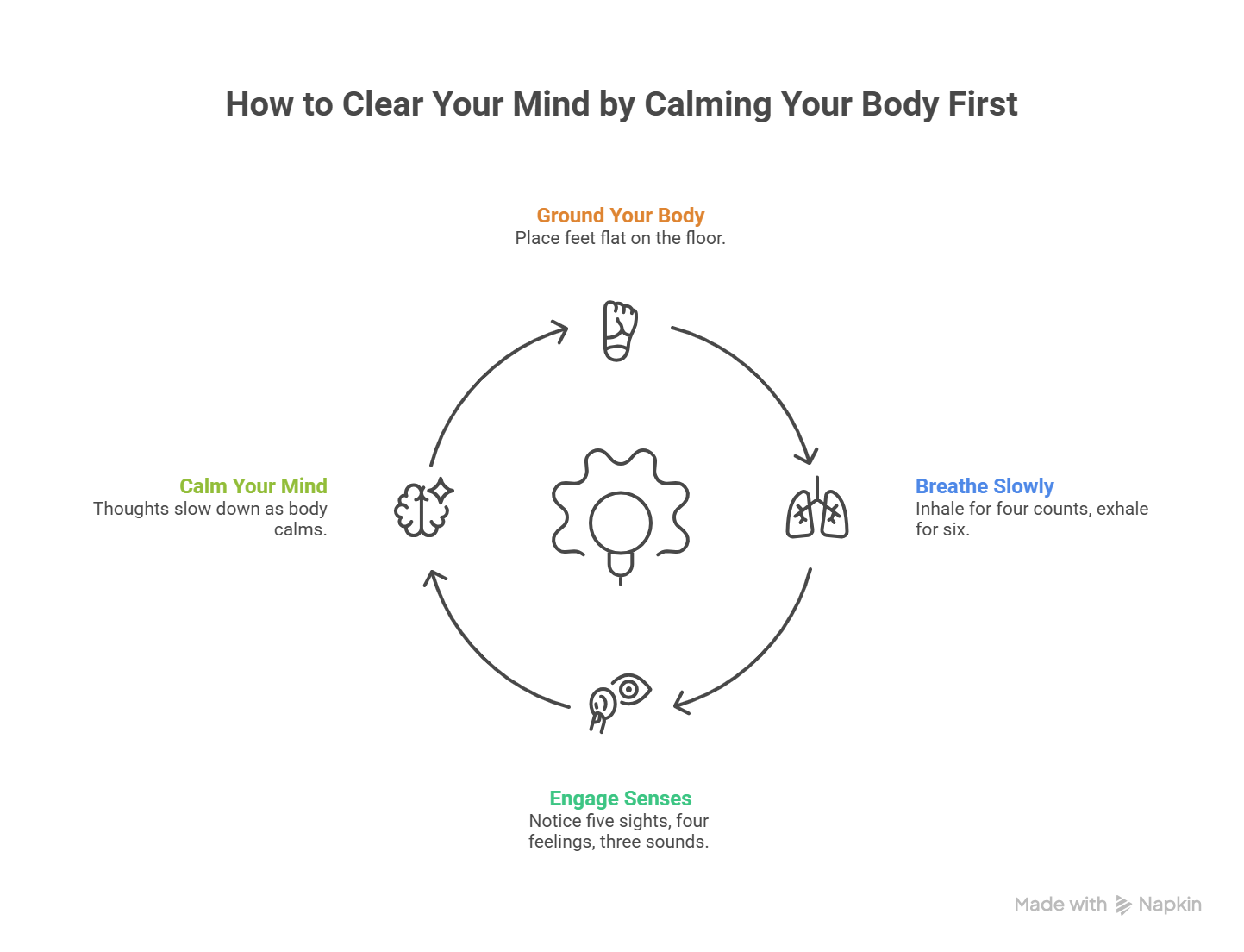
How to Clear Your Mind by Calming Your Body First
One of the most overlooked strategies to clear your mind is starting with your body. Thoughts slow down when your physical state becomes calmer.
Try this simple grounding sequence:
- Place both feet flat on the floor.
- Take a slow breath in through your nose for four counts.
- Exhale gently for six counts.
- Notice five things you can see, four you can feel, and three you can hear.
This sensory awareness signals to your brain that you are in the present moment. When your body feels safer, your thoughts naturally begin to settle.
You do not need long meditation sessions to feel relief. Even two minutes of intentional breathing can shift your state.
Interrupting Mental Loops with Structured Reflection
When thoughts are repetitive, they follow predictable patterns. Writing them down can create distance.
Consider using a simple three-column method:
| Thought | Emotion | Alternative Perspective |
| I am going to fail | Fear | I can prepare and ask for support |
| I always say the wrong thing | Shame | I am learning and growing socially |
| I cannot handle this | Overwhelm | I can take one step at a time |
Creating Mental Boundaries Around Worry
Many people try to push worry away, only to have it return stronger. Instead of suppressing it, try containing it.
You might designate a 15-minute “worry window” each day. During that time, allow yourself to think through concerns intentionally. When worries arise outside that window, gently remind yourself that you have scheduled time to address them.
This technique builds psychological boundaries. Over time, your brain learns that it does not need to remain on constant alert.
If worry feels constant and intrusive, it may be helpful to explore deeper support for anxiety patterns in a therapeutic setting.
Using Micro Resets Throughout Your Day
Clearing your mind does not require waiting until you are overwhelmed. Small resets can prevent mental buildup.
You might:
- Step outside for fresh air between meetings.
- Stretch your shoulders and neck.
- Drink a glass of water gradually and mindfully.
- Close your eyes for sixty seconds.
These brief pauses regulate your nervous system and reduce cognitive overload. Think of them as emotional hygiene.
When you consistently practice micro resets, you strengthen your capacity for self-regulation.
Addressing the Emotional Root Beneath Racing Thoughts
Sometimes racing thoughts are not just about busyness. They may reflect unresolved emotions. You might be avoiding grief, anger, or disappointment. When feelings remain unacknowledged, they surface as mental noise.
Ask yourself:
- What emotion might be underneath these thoughts?
- Am I trying to control something that feels uncertain?
- What am I afraid would happen if I slowed down?
Gently identifying the emotional layer can reduce its intensity. Emotional awareness quiets the mind more effectively than distraction.
This deeper reflection is an important part of understanding how to clear your mind in a sustainable way.
Improving Sleep to Reduce Cognitive Overload
Sleep and mental clarity are closely connected. When you are sleep-deprived, your brain struggles to regulate emotion and attention.
You might support better rest by:
- Limiting screen time before bed.
- Creating a consistent sleep routine.
- Avoiding heavy mental tasks late at night.
- Writing down tomorrow’s tasks before lying down.
Preparing your mind for rest can significantly reduce nighttime thoughts.
Practicing Self-Compassion When Your Mind Feels Chaotic
Many people add another layer of stress by criticizing themselves for having racing thoughts. You might think, “Why can’t I just relax?” or “There is something wrong with me.”
Instead, try responding with gentleness:
- My mind is busy because I care.
- It makes sense that I feel overwhelmed.
- I am allowed to pause.
Self-compassion reduces internal pressure. When you stop fighting your thoughts, they lose intensity.
Remember, learning how to clear your mind is a skill. It takes repetition and patience.
Final Reflections
Are you craving relief? Racing thoughts can be exhausting, but they are not permanent. With grounding techniques, cognitive reframing, emotional awareness, and self-compassion, your mind can become a quieter, steadier place.
If you feel stuck in patterns of overwhelm, anxiety, or low mood, you are welcome to connect with me. In my therapy, we can explore what is fueling your mental noise and develop tools that help you feel more centered and present.
FAQs
- Is it normal to have constant racing thoughts?
Yes. Stress, anxiety, and insufficient sleep can all increase mental activity. Persistent racing thoughts may benefit from therapeutic support.
- Can mindfulness really help clear my mind?
Mindfulness does not eliminate thoughts, but it helps you observe them without becoming entangled in them, which reduces their intensity.
- How quickly can I calm my mind?
Some techniques, such as slow breathing or grounding, can create noticeable shifts within minutes. Consistency strengthens long-term results.
- Why do my thoughts get worse at night?
Nighttime reduces distractions, making worries more noticeable. Fatigue can also weaken emotional regulation.
