

One of the most common worries people bring to their first appointment is not about therapy itself, but about what to talk about in therapy once they are sitting there. The fear of an awkward silence, or of wasting the time with something that feels too small, keeps many people from beginning at all.
I am Dr. Arlene Brewster, a certified IFS therapist licensed in both Maine and New Hampshire, and I want to offer you a more honest answer than the usual list of suggested topics.
Why the Question Itself Reveals Something Useful
If you find yourself anxious about what to talk about during counseling, that anxiety is rarely random. It points to a part of you that is used to filtering what gets shared, deciding in advance what is worth someone else’s attention.
That filtering part likely developed for a real reason, perhaps in a family where certain topics were unwelcome, or in a relationship where vulnerability was met with dismissal.
Bringing that very worry into the room is a more useful starting point than searching for the right topic. Saying something like, I am not sure what is worth bringing up, opens a conversation about that filtering part itself, which is frequently more revealing than whatever topic you had originally planned to discuss.
Curious how this kind of work carries out in session? Talk to me and explore more about my approach and how we can work together.
What to Talk About in Therapy When Nothing Feels Urgent
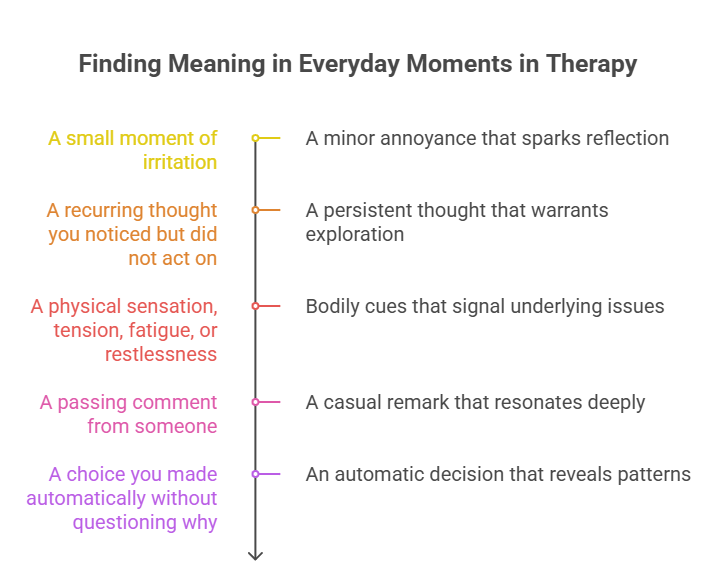
Many people assume therapy is only useful when there is a crisis to discuss. This leads to a common but unnecessary hesitation: feeling like an ordinary week does not contain enough material for a session. In practice, some of the most meaningful work happens in sessions where nothing dramatic occurred.
- A small moment of irritation that seemed disproportionate to what actually happened.
- A recurring thought you noticed but did not act on.
- A physical sensation, tension, fatigue, or restlessness that showed up without an obvious cause.
- A passing comment from someone that stayed with you longer than expected.
- A choice you made automatically without questioning why.
These small, seemingly minor details lead directly to the parts of you doing the most active work beneath the surface of daily life.
Why Small Moments Sometimes Matter More Than Big Events
A substantial life event usually announces its own importance. A small moment of irritation or unease does not, which is exactly why it tends to go unexamined. These smaller moments frequently carry information about a part of you that is quietly active in ways larger events can sometimes obscure.
Bringing Patterns Instead of Just Events Into the Room
One angle barely discussed in guidance about what to talk about in therapy is the value of recognizing patterns across time, not only individual incidents. A single argument with a partner is useful to discuss.
Noticing that you withdraw in the exact same way during every disagreement, regardless of the specific topic, often reveals far more.
| Single Event | Pattern Across Time |
| One difficult conversation with a partner | Always going quiet during any disagreement |
| Feeling anxious before one specific meeting | Feeling anxious before any situation involving evaluation |
| A moment of self-criticism after a mistake | A consistent inner voice that responds harshly to any error |
Bringing patterns into session, rather than only the most recent example, helps both of us see which part of you is generating the repeated response.
Want to explore the patterns shaping your relationships? Read more about my relationship counseling approach.
Why Some Topics Feel Too Shameful to Bring Up
Shame is one of the most significant barriers to deciding what to talk about during counseling, and it rarely gets named directly in general advice on the topic.
Many people privately carry thoughts, reactions, or past behaviors they assume would be judged if spoken aloud. That assumption usually traces back to a part of you that learned certain truths were not safe to share.
In my experience, the things people are most reluctant to bring up are exactly what would be most useful to discuss. Naming the reluctance itself, and not the content you are avoiding, is frequently a gentler way to begin approaching it.
What to Talk About in Therapy When You Feel Stuck Between Sessions
If you find yourself with nothing specific in mind before an appointment, noticing your most recent internal reaction to something ordinary, a moment of frustration in traffic, a wave of sadness during a quiet evening, becomes a productive starting point.
The content itself matters less than your willingness to get curious about why that particular reaction surfaced.
Letting the Right Topic Reveal Itself Naturally
You do not need a polished agenda to make good use of a session. Some of the most meaningful therapeutic work begins with an unfinished thought, a vague unease, or just naming that you are not sure where to start.
I currently offer online consultations, as well as in-person sessions for those in the Maine and New Hampshire region.
Want to explore what matters most to you? Contact me now and schedule a consultation.
FAQs
What to talk about in therapy if I had an uneventful week?
Small reactions, passing thoughts, or unexplained tension lead to meaningful material, even when nothing significant seemed to happen.
Is it okay to bring up the same topic repeatedly across sessions?
Yes. Returning to the same theme signals an important pattern worth understanding more deeply, instead of a sign that you are not making progress.
What if I feel embarrassed about what I want to discuss?
That embarrassment is worth naming directly. It points to shame around a specific part of you, and addressing that reluctance is frequently as valuable as the topic itself.
Should I prepare topics in advance before each session?
It can help some people, but it is not necessary. Many productive sessions begin without a plan, simply by noticing what comes up naturally in the moment.
Can I talk about relationship patterns, and not specific incidents?
Yes, and this is more useful. Discussing a recurring pattern, rather than only the most recent example, helps reveal what is truly driving the repeated response.
