

If you are searching for how to heal from trauma, you have probably already tried some combination of self-help books, breathing exercises, and sheer willpower. Those efforts are not wasted, but they stop short of producing real relief.
I am Dr. Arlene Brewster, a certified IFS therapist, and I want to offer a more thorough overview of what genuine healing requires, beyond the coping strategies most articles stop at.
Why Coping Strategies Alone Rarely Answer How to Heal From Trauma
Most guidance on this topic focuses on managing distress in the moment: grounding techniques, breathing exercises, and journaling prompts.
These tools have real value, and I am not dismissing them. But they tend to address the symptom layer of trauma without reaching what is generating the symptoms in the first place.
Trauma lives in specific parts of you, protective parts that developed strategies to keep painful material at a distance and exile parts that carry the original pain itself.
Coping tools help protective parts manage daily life more comfortably. They do not, on their own, help exile parts release what they carry. That deeper layer is where lasting healing happens.
The Stage Most Healing Guides Skip Entirely
Before any meaningful processing of traumatic material can happen, the protective parts managing your daily functioning need to trust that it is safe to step back.
Most guidance jumps straight to processing, which can feel like being asked to relive pain before you have built any internal safety to hold it.
Here are some common techniques for coping:
- Notice which protective strategies you rely on most, whether that is staying busy, intellectualizing, or emotional withdrawal.
- Approach those strategies with curiosity, since they developed to keep you safe.
- Build a felt sense of safety in your body before attempting to process difficult material.
- Allow the pace of healing to be set by what your internal system can tolerate, not by an external timeline.
Why Forcing Yourself to Confront Trauma Head On Can Backfire
A common but counterproductive belief about how to heal from trauma is that you need to push through it forcefully, facing the worst of it as soon as possible.
For many adults, this is more retraumatizing than healing, because it bypasses protective parts with legitimate reasons for caution. Healing goes further and lasts longer when it respects that caution.
The Role of Shame in Why Trauma Healing Stalls
Shame is one of the most underaddressed barriers to trauma recovery, and it hardly ever gets named directly in general advice.
Many adults carry a quiet belief that they should have prevented what happened or that needing this much support reflects some personal failing. That shame does not lift with time alone. It is held by a specific part of you and continues shaping how safe you feel being vulnerable, even in therapy.
Healing that does not address shame directly can stall, because the part carrying it remains unconvinced it is safe to let deeper work happen. Naming shame explicitly and approaching it with compassion is what allows the rest of the process to move forward.
Curious how shame factors into your own healing process? Connect with me to learn more about it.
What Healthy Healing Looks Like Over Time
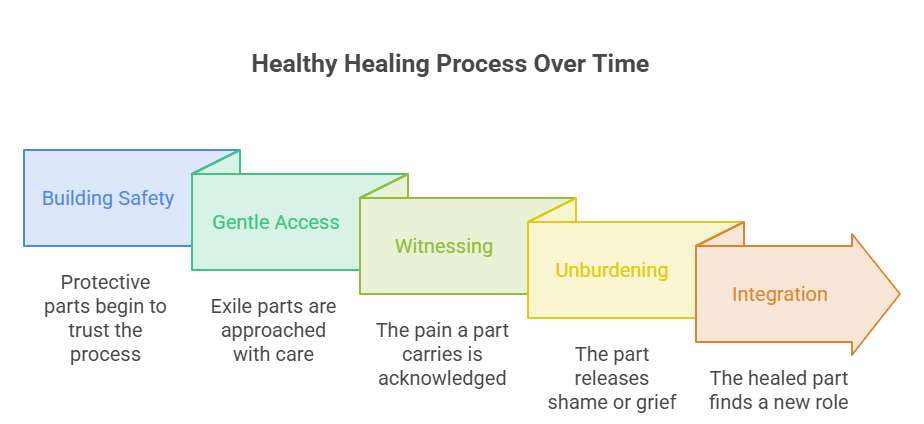
| Stage | What Tends to Happen |
| Building safety | Protective parts begin to trust the process and relax slightly |
| Gentle access | Exile parts are approached with care, and not confronted directly |
| Witnessing | The pain a part carries is finally acknowledged with compassion |
| Unburdening | The part releases what it has carried, often shame or grief |
| Integration | The healed part finds a new, less burdened role in your internal system |
Why Childhood Neglect Requires a Different Healing Approach
Adults whose trauma stems from chronic neglect rather than a single dramatic event find that healing takes a different shape.
There is no isolated incident to process. Instead, the work involves understanding how an entire developmental environment shaped your sense of safety and self-worth. This kind of healing unfolds more gradually, addressing identity and relational patterns alongside specific memories.
Want to understand this approach in more depth? Read more about my child trauma therapy work.
Why the Relationship With Your Therapist Matters More Than the Technique
Research on trauma recovery consistently shows that the value of the relationship between client and therapist predicts outcomes more reliably than any specific technique. This matters enormously for healing from trauma, because being genuinely understood by a steady, attuned person is itself part of what heals, particularly for adults whose trauma involved relational harm or neglect.
My approach centers on this relationship, working with the parts of you that have been carrying difficult experiences through trauma-informed individual therapy built around genuine attunement instead of a fixed program. Book your consultation now!
Summing Up
Learning how to heal from trauma is not about gathering more coping tools, although those have their place. It is about understanding the parts of you that have been protecting you and carrying pain and offering them the care that allows real change to take root.
I currently offer online consultations, as well as in-person sessions in the Maine and New Hampshire regions.
Ready to begin a deeper healing process? Reach out today.
FAQs
1. How do I know if I am healing from trauma the right way?
There is no single right way, but healing that respects your pace, addresses shame directly, and builds internal safety before deep processing lasts longer than approaches that push too quickly.
2. Can I learn how to heal from trauma without professional support?
Some progress is possible alone, particularly with coping strategies. Deeper healing, especially involving shame or chronic neglect, usually benefits significantly from a trained therapeutic relationship.
3. Why does my trauma healing feel like it stalls and then suddenly moves again?
This is a normal pattern. Protective parts test whether it is safe to continue before allowing deeper material to be addressed, which can feel like stalling followed by sudden movement.
4. Does healing from trauma mean I will stop having any reactions to triggers?
Not entirely, but reactions become less intense and easier to understand over time as the parts carrying the original pain feel more resolved.
