
The way you connect to people you love, and the way you respond when that connection feels threatened, is not random. It has deep roots.
Emotional attachment is the invisible architecture underlying most of what happens in close relationships: why certain moments feel unbearably distant, why some arguments follow the exact same shape no matter how many times you resolve them, and why being truly known by another person can feel both like the thing you want most and the thing that frightens you.
I am a certified IFS therapist licensed in both Maine and New Hampshire, and helping adults understand their attachment patterns is some of the most meaningful work I do.
Why Your Attachment Pattern Is Not a Flaw in Your Personality
An important thing I want to offer here is a reframe.
Attachment styles are not character traits you were born with or personality flaws to be corrected. They are learned responses. They developed in early childhood as protective adaptations to the emotional environment you grew up in.
If the people who cared for you were consistently warm and responsive, you likely developed a secure foundation for connection. If they were inconsistent or emotionally unavailable, or if your childhood included neglect or a sense that your needs were too much, your nervous system adapted.
That adaptation made sense at the time. The parts of you that learned to be vigilant, or to limit your own needs, or to keep people at a manageable distance were protecting you. The difficulty is that those same parts continue operating in adult relationships, without your conscious awareness.
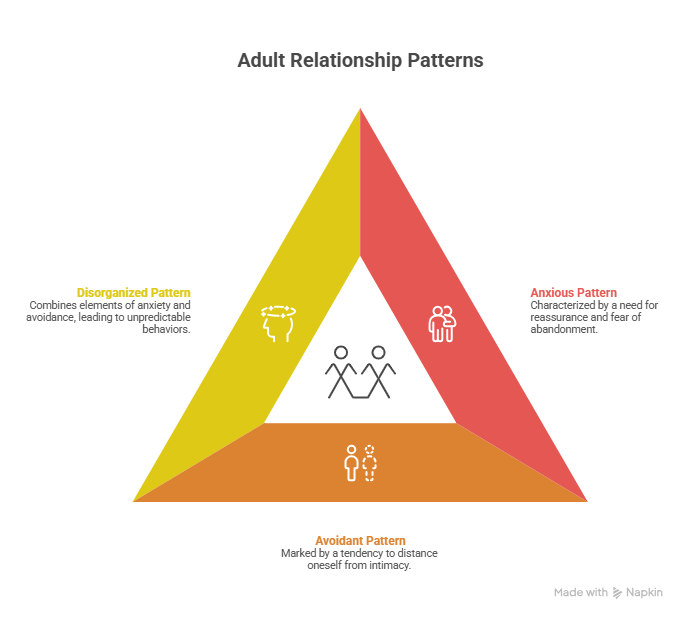
The Three Patterns That Show Up Most Often in Adult Relationships
The Anxious Pattern
If you carry an anxious attachment pattern, a part of you is preoccupied with the security of your relationships.
You may find yourself hyperaware of small shifts in your partner’s mood, reading distance as rejection, or feeling an urgency to restore a connection that your partner experiences as pressure.
This part developed because closeness felt unreliable early on. It was learned that you have to monitor carefully and work hard to keep people close.
The Avoidant Pattern
If you carry an avoidant pattern, a part of you has learned that needing others is unsafe or ineffective.
You may withdraw when emotional intensity rises, feel flooded by your partner’s need for closeness, or find that vulnerability triggers a part of you that wants to disengage.
This is not coldness. It is a protective strategy that developed because connection came with a cost or because emotional expression was consistently met with discomfort or dismissal.
The Disorganized Pattern
Less commonly discussed but important to name: some adults carry what is called a disorganized or fearful attachment pattern. This develops in the context of more significant childhood adversity, including neglect, abuse, or a caregiver who was simultaneously a source of safety and fear.
Adults dealing with DID (Dissociative Identity Disorder) frequently carry this pattern, as do many adults whose early experiences were chronically unpredictable. The push and pull of wanting closeness while fearing it deeply can be exhausting and confusing, and it responds well to the kind of compassionate, parts-aware work I do.
How Emotional Attachment Patterns Show Up in Couples’ Dynamics
| Pattern Combination | Common Relational Dynamic |
| Anxious + Avoidant | Pursue-withdraw cycle: each triggers the other’s deepest fear |
| Anxious + Anxious | High emotional intensity; difficulty with repair after conflict |
| Avoidant + Avoidant | Surface calm with underlying disconnection and unspoken needs |
| Secure + Anxious or Avoidant | Stabilizing influence, but can produce its own frustrations |
Healing Emotional Attachment Wounds in Adults
In my work with adults, I focus particularly on the parts that carry the deepest attachment wounds. Often these are exile parts that formed very early, carrying beliefs like: I am too much, I am not enough to be loved, needing people leads to pain, or being vulnerable means being hurt.
These beliefs were absorbed in a context where they made sense. Unburdening them means helping those parts experience something different: genuine witness, care, and the understanding that they do not have to keep protecting you in the same way they once did.
- Shame is almost always woven into attachment wounds, and it responds deeply to this kind of care.
- Adults who experienced neglect carry a particular kind of invisible wound because their pain was not witnessed.
- Understanding your attachment pattern changes how you interpret your own reactions in real time.
- Healing does not require a perfect relationship; it requires a safe enough one.
For adults who have particularly difficult pasts, including those with DID or significant childhood adversity, my childhood trauma therapy provides a foundation that makes attachment healing more accessible.
Final Words
You do not have to have a diagnosis or a dramatic history to benefit from exploring your emotional attachment patterns. Most adults find that simply having language for what they experience internally in close relationships is quietly transformative.
When you can recognize that the part of you that goes cold during conflict is protecting something vulnerable, instead of judging yourself for being unavailable, something shifts.
As a licensed therapist in Maine & New Hampshire, I offer online consultations for adults. If understanding yourself more deeply in the context of your relationships feels like something you are ready to explore, schedule a consultation with me today.
You deserve a space where your patterns are understood with care, not just explained.
FAQs
1. Can emotional attachment patterns really change in adulthood?
Yes. Research supports this, and I have seen it consistently in my clinical work. It requires a safe relational experience sustained over time, which therapy can provide.
2. What is the difference between attachment anxiety and general anxiety?
Attachment anxiety is specifically activated by closeness and connection. It involves a part of you that monitors relationship security. General anxiety can involve many protective parts activated by different triggers.
3. Do my attachment patterns affect how I parent?
They can. Adults who experienced neglect or inconsistency in childhood find that understanding their own attachment patterns helps them respond more thoughtfully to those in their care.
4. Is Dissociative Identity Disorder related to attachment?
Yes. DID often develops in the context of early relational trauma and is closely linked to disorganized attachment. IFS is a particularly respectful and effective approach for this work.
5. How does shame connect to attachment?
Shame and attachment wounds are deeply intertwined. The belief that you are fundamentally unlovable or too much is usually at the core of insecure attachment, and addressing it is central to the healing process.
