
This is one of the most honest questions a couple can ask, and it deserves an honest answer. Can couples counseling save a relationship? The short answer is sometimes, and the outcome depends far more on specific factors than most people realize when they first reach out.
As a certified IFS therapist, I want to give you something more useful than reassurance here. What I have learned over thirty years of working with couples is that the question of whether counseling will save your marriage is usually the wrong place to start. The more important question is whether you are both willing to understand what actually happened between you.
The Difference Between Saving a Relationship and Transforming One
When couples ask, “Can couples counseling save a relationship?” they are generally hoping to return to something they lost, a version of the partnership that felt easier, warmer, or less burdened.
That hope is completely understandable. But in my experience, the most lasting outcomes do not come from restoring what was. They come from building something genuinely different on a foundation of mutual understanding that did not exist before.
This matters because many relationships that feel like they are in crisis are actually in a transition. The patterns that are causing the most pain are signals that something needs to change, not that the relationship itself is irreparably broken.
When both partners are willing to look at what those patterns are protecting and where they came from, the relationship can become something neither person had yet imagined.
What Actually Determines Whether Couples Counseling Works
| Factor | Why It Matters |
| Willingness to self-reflect | Change requires looking inward, not only at your partner |
| Both partners present, even if uncertain | Uncertainty is workable; complete disengagement is harder |
| History of neglect or childhood adversity | Trauma-informed work addresses the root, not just the surface |
| Presence of shame | Unaddressed shame drives most destructive patterns in couples |
| Timing of seeking help | Earlier is generally easier, but later is still possible |
The factor I see matter most consistently is not the severity of the crisis that brings a couple to therapy. It is whether each partner is genuinely willing to look at the parts of themselves that have contributed to the dynamic, even when that is uncomfortable.
Can Couples Counseling Save a Relationship Where Trust Has Been Damaged
Trust is the most complex thing to rebuild in a relationship because it cannot be restored by promise alone. It is rebuilt through repeated experience: moments where one partner is vulnerable, and the other responds with care, over and over, until the nervous system of the wounded partner begins to believe that safety is possible again.
This is slow work, and it requires more than goodwill. It requires each partner to understand the parts of themselves that respond to vulnerability with defense, withdrawal, or control.
A partner who shuts down emotionally when confronted is not necessarily indifferent. They may have a deeply protective part that learned early that showing distress was not safe. When their partner can understand that, rather than reading it as rejection, the entire dynamic shifts.
Will Counseling Save My Marriage If My Partner Is Not Fully Committed?
This is a version of the question I hear often, and it carries a lot of pain. The honest answer is that couples’ work is more effective when both partners are willing, even if they arrive with very different levels of hope.
A partner who is uncertain is not the same as a partner who is disengaged. Uncertainty is workable. What I do is create a space where both positions are respected and where the uncertainty itself becomes something we explore rather than something to be overcome.
Individual sessions can also run alongside or instead of couples sessions when one partner is not yet willing to participate. Understanding your own parts and reactions changes how you move within the relationship, and that change sometimes creates an opening that was not there before.
When Counseling Points Toward a Different Outcome
I want to address something that most articles on this topic avoid. Not every relationship, even with genuine effort on both sides, continues.
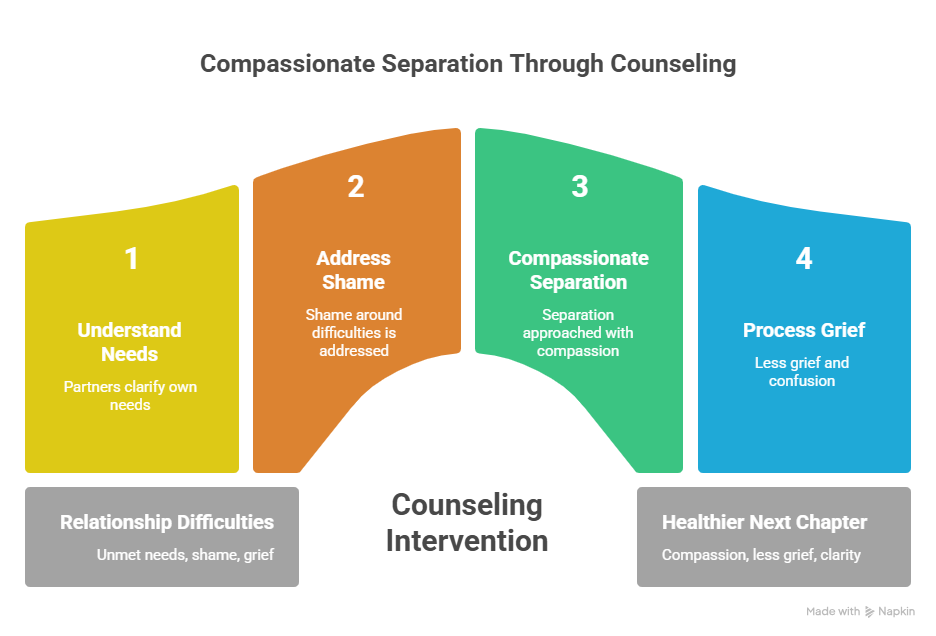
Sometimes the work of counseling leads a couple to a clearer understanding that the relationship is not able to become what both people need. That is not a failure of counseling. In fact, it can be one of the most meaningful outcomes.
- Both partners develop a clearer understanding of their own needs and patterns.
- Shame around the relationship’s difficulties is addressed with care.
- If separation comes, it can be approached with more compassion and less damage.
- Each person carries less unprocessed grief and confusion into their next chapter.
If you are ready to explore what is possible for your relationship, my couples therapy page shares more about how I work and what to expect.
An Honest Invitation to Begin
Can couples counseling save a relationship? With the right approach, genuine willingness, and enough care for the internal worlds of both partners, the answer for many couples is yes.
As a licensed therapist in both Maine and New Hampshire, I offer online consultations for adults, and I encourage you to reach out when you are ready. Whatever outcome this process ultimately leads toward, understanding what happened between you is always worth the effort.
FAQs
1. Can couples counseling save a relationship that has been struggling for many years?
Yes, though entrenched patterns require more sustained work. Long-standing struggles often point to deep protective parts that respond well to an IFS-informed approach.
2. Will counseling save my marriage if there has been emotional disconnection for a long time?
Emotional disconnection is one of the most treatable relational patterns in couples work. It usually reflects protective parts, not an absence of care.
3. What if I feel more shame about the state of the relationship than my partner does?
Shame is commonly asymmetrical in couples. I work with both partners’ internal experience, and shame is something I address directly rather than leaving it unaddressed.
4. Is it possible to come to counseling individually if my partner won’t come?
Yes. Individual sessions focused on relational patterns can be very effective and sometimes create conditions that make couples work possible later.
5. How soon might we notice whether counseling is making a difference?
Many couples notice shifts in understanding within the first few sessions. Behavioral change in deep patterns typically takes longer, which is why consistency matters.
