
When you have lived through painful experiences, the effects rarely stay in the past. They show up in how you react to relationships, how you speak to yourself at the end of a long day, or how certain moments seem to pull you backward without warning.
IFS therapy for trauma offers something different from most approaches to healing. Rather than treating your pain as a symptom to be eliminated, it invites you to understand where that pain came from and why different parts of you have worked so hard to protect you from it.
I am Dr. Arlene Brewster, a certified IFS therapist licensed in both Maine and New Hampshire, and I have spent over thirty years watching this approach help adults find lasting relief.
Why Trauma Does Not Easily Disappear Over Time
One of the most painful misconceptions about trauma is that time alone heals it. For many adults, years have passed since experiences involving neglect, abuse, loss, or an unsafe childhood, yet those experiences still shape how they feel today.
Trauma is not just a memory stored in the mind. It lives in parts of you that learned the world was unpredictable or dangerous, creating patterns like withdrawal, hypervigilance, shame, or difficulty trusting yourself.
Healing begins when you stop seeing these patterns as character flaws and start seeing them as responses that once made sense. That is what IFS therapy for trauma makes possible.
What IFS Therapy for Trauma Looks Like in Practice
Internal Family Systems therapy is built on the idea that you are not one single, fixed self. You carry within you many different parts, each with its own history, its own fears, and its own way of trying to help you survive.
Some parts are protected by shutting down. Others protect by staying angry or by driving you to keep achieving, so there is no room to feel. And beneath all of those protective parts are the more vulnerable ones, the exiles, that carry the original pain.
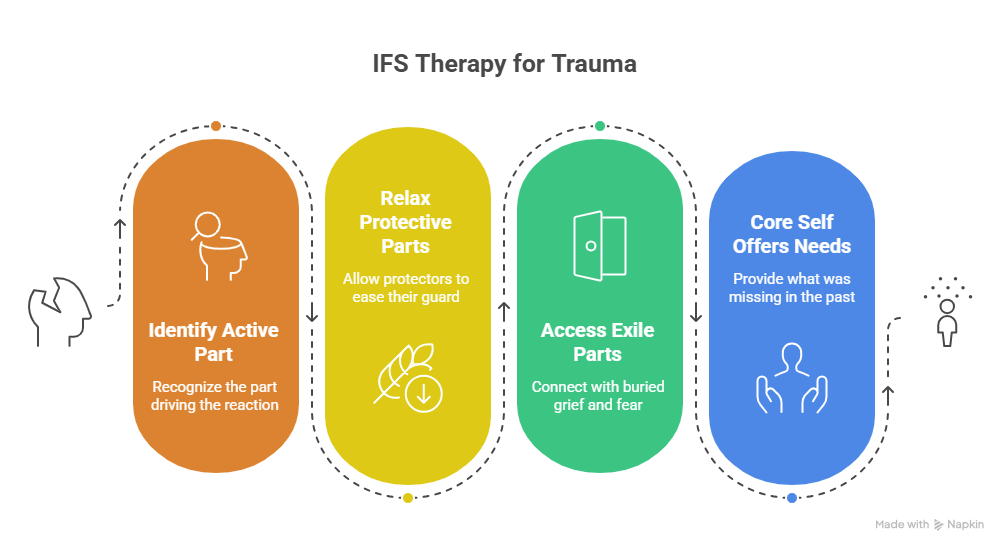
In our work together, I help you slow down enough to notice these parts rather than being swept along by them. Some of the IFS therapy techniques I use include:
- Helping you identify which part of you is active in a difficult moment.
- Gently making space for protective parts to relax rather than forcing them aside.
- Accessing the exile parts that carry unprocessed grief, shame, or fear from earlier experiences.
- Guiding your core self to offer those parts what they actually needed.
- Working toward unburdening, releasing the beliefs and emotions a part has carried for years.
The Role of Shame in Trauma Healing
Shame is one of the most quietly persistent wounds that trauma leaves behind. It is different from guilt, which is about something you did. Shame goes deeper. It is the belief that something is fundamentally wrong with you. Many of the adults I work with have carried this feeling for decades, often without ever naming it.
IFS therapy explained simply: when a part of you carries shame, it is usually an exile that absorbed a message from early experiences that it was not enough, not lovable, or somehow responsible for what happened.
Healing that part means listening to it, not silencing it. It means letting your core self step forward with compassion rather than judgment.
Adults Who Experienced Difficult Childhoods Deserve Specialized Care
Many people who seek me out are adults whose childhood experiences included neglect, emotional unavailability, or situations where they learned very early that their feelings were not welcome. These experiences shape the nervous system in lasting ways, and they often do not fit neatly into clinical categories.
If you have found yourself wondering whether what you experienced qualifies as trauma, I want to say clearly: if it left a mark on how you experience yourself and others, it matters. My trauma therapy work with adults is rooted in this belief, and I approach every person’s history with the care it deserves.
How IFS Therapy for Trauma Differs from What You May Have Tried Before
| What Some Approaches Do | What IFS Therapy Does |
| Targets symptoms for reduction | Explores the purpose behind symptoms |
| Encourages reframing or disputing thoughts | Invites curiosity about the part generating the thought |
| Focuses on behavioral change | Focuses on internal relationships and understanding |
| Can feel like self-correction | Feels like self-compassion |
Beginning IFS Therapy with Me!
As a licensed therapist in Maine & New Hampshire, I offer online consultations for adults to help heal deep wounds. If you have been carrying the weight of difficult experiences and questioning whether healing is genuinely possible for you, I encourage you to get in touch.
Healing is not about erasing your history. It is about changing your relationship to it. When the parts of you that have been working so hard finally feel safe enough to rest, the difference is profound. That is what I am here to help you find.
FAQs
1. How is IFS therapy for trauma different from talk therapy?
Talk therapy focuses on discussing and analyzing experiences. IFS goes deeper by helping you build a relationship with the internal parts carrying those experiences, which can lead to more lasting emotional relief.
2. What are the main IFS therapy benefits for adults with childhood trauma?
Adults notice reduced shame, a gentler internal voice, less reactivity in relationships, and a clearer sense of their own core self after sustained IFS work.
3. Can IFS therapy techniques help with dissociative identity disorder?
Yes. IFS is particularly well-suited to working with DID because it approaches the internal system with respect and curiosity, treating every part as meaningful rather than problematic.
4. Do I need to remember specific events for IFS therapy to work?
No. Many adults carry the effects of neglect or early adversity without clear memories. IFS works with how your parts function now, not only with recalled events.
5. Is IFS therapy explained in a way beginners can understand?
Yes, and that is part of why people respond to it so well. The language of parts is intuitive. Most people immediately recognize what it means to have a part of them that wants to connect and another part that pulls back from closeness.
