
Asking how to stop being a narcissist is one of the more courageous questions a person can bring into a therapy room. It requires a level of self-awareness and honest reckoning that most people who struggle with narcissistic patterns never reach.
As a licensed psychologist and certified IFS therapist, I want to offer a perspective that goes beyond the usual advice. Practicing empathy and asking people how they feel are not wrong suggestions. They simply miss the internal structure that drives narcissistic behavior in the first place.
What Narcissistic Behavior Is Often Protecting
Before exploring how to stop being a narcissist, it is worth understanding what narcissistic patterns are often protecting. In IFS, no behavior is viewed as a flaw to be eliminated. Every behavior is a part of ourselves that developed a role, usually protective, in response to something painful.
Many adults who exhibit narcissistic patterns carry deep shame underneath the self-elevating or dismissive behaviors. A part of them learned early, through experiences of childhood neglect, emotional invalidation, or an environment where vulnerability was put down or ridiculed, that it was not safe to be ordinary.
The part that inflates the self, controls others, or criticizes those around it is working hard to ensure that the vulnerable inner self never has to feel that level of exposure again.
The Internal Work That Must Come Before Behavioral Change
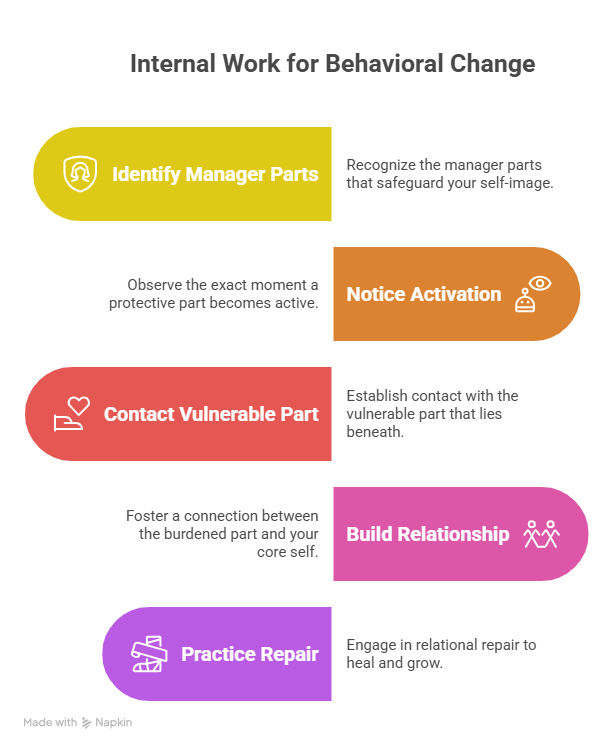
Genuine progress begins internally. In IFS therapy, I work with adults through the following process, which is slower and more uncomfortable than behavioral strategies and also far more durable:
- Identify the manager parts that protect your self-image or control your relationships, and approach them with curiosity rather than shame.
- Notice the precise moment a protective part activates, whether it is the part that dismisses, deflects, or elevates, and practice pausing, not acting from it.
- Make contact with the vulnerable part underneath, the one carrying shame, fear of rejection, or the belief that being imperfect means being discarded.
- Build a relationship between that burdened part and your core self so that the self, rather than a protective manager, begins to lead your responses in relationships
- Practice relational repair not from a place of performing accountability, but from a place of genuinely understanding the impact of your behavior on others
This process is not linear. It unfolds at the pace of your nervous system, and it requires a skilled IFS therapist who can hold the complexity of your internal system without shaming you for what they find.
How Shame Drives the Cycle and How to Break It
One of the angles rarely addressed in content about how to stop being a narcissist is the role shame plays in perpetuating the very patterns you want to change.
When you receive honest feedback that your behavior has hurt someone, a shame response activates immediately. You might notice:
- A defensive part that immediately challenges the accuracy of the feedback.
- A part that criticizes the person offering it to make their concern seem invalid.
- A part that retreats into silence or superiority to avoid the feeling entirely.
- An internal shift that feels like a threat, not information.
This is not willful cruelty. It is a protective response to a feeling that is genuinely overwhelming. The shame of having caused harm collides with the deeper shame of believing, at some level, that you are fundamentally inadequate.
Learning to interrupt this cycle means building what IFS calls “self-energy”: the capacity to be present with difficulty without needing to manage or escape it.
When to Seek Arlene’s Professional Support
If you are serious about how to stop being a narcissist, professional support is not optional. The internal work described above requires a therapeutic relationship with someone who can hold the full complexity of what you are carrying without either conflicting with your defenses or shaming you into collapse.
A skilled IFS therapist provides:
- A space where all parts of you, including the ones that have caused harm, are approached with curiosity rather than condemnation.
- Clear, bounded accountability that does not collapse into blame.
- Pacing that allows the vulnerable parts beneath the protective ones to emerge safely.
- Ongoing attunement to the shifts in your internal system across the arc of the work.
Whether you are coming to this through a relationship in crisis, a period of personal reflection, or couples therapy that has surfaced these patterns, the door is open.
As a licensed therapist in Maine and New Hampshire, I offer online consultations for individuals who are ready to do this kind of serious, grounded work.
Conclusion
Asking how to stop being a narcissist is not just a therapeutic question. It is a statement of intent.
It means you are willing to look honestly at the parts of yourself that have caused harm, to understand them instead of suppressing them, and to build the internal conditions that make genuine change possible.
I welcome you to schedule an online consultation. As a licensed IFS therapist in both Maine and New Hampshire, I am here to walk alongside you through this kind of meaningful, lasting work.
The change you are looking for is not about becoming a different person. It is about finally meeting the parts of yourself you have been working so hard to hide and giving them something better than the job they have been doing.
FAQs
1. Can narcissistic patterns genuinely change with therapy?
Yes, though it requires sustained work rather than insight alone. Change is most possible when the person is genuinely motivated and working with a clinician skilled in treating complex protective internal systems.
2. Is IFS therapy specifically effective for narcissistic patterns?
IFS is well-suited for this work because it addresses the underlying shame and vulnerability that protective narcissistic behaviors are designed to manage, without targeting the visible behaviors in isolation.
3. Do I need a formal diagnosis to work on narcissistic patterns in therapy?
No. Many adults benefit from this work without meeting the clinical threshold for narcissistic personality disorder. Recognizing harmful patterns and wanting to change them is a sufficient starting point.
4. How long does meaningful change typically take?
It varies by individual and the depth of the internal work involved. For those exploring how to stop being a narcissist, most people notice meaningful internal shifts within several months of consistent IFS therapy, with relational changes following gradually over time.
