
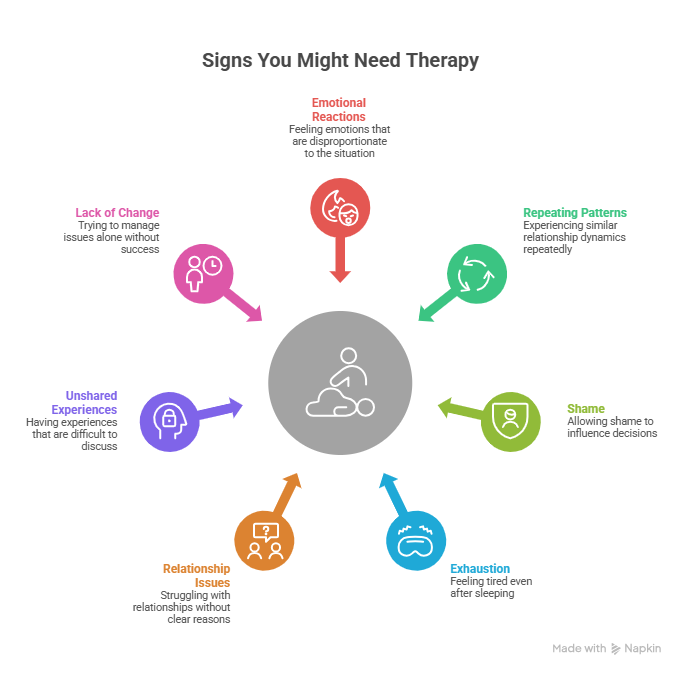
Most people do not arrive at therapy because one clear thing broke. They arrive because something has been quietly building for a long time, and they have finally run out of ways to manage it alone.
Recognizing the signs you need therapy is rarely dramatic. It is more often a slow accumulation of moments where your usual strategies stop working, and the weight of what you are carrying begins to show up in ways you can no longer ignore.
As a certified IFS therapist licensed in both Maine and New Hampshire, I want to name these signs in a way that goes beyond the standard lists. What I describe below are not just symptoms. They are patterns, and patterns carry meaning.
Sign 1: Your Emotional Reactions Feel Bigger Than the Moment Warrants
One of the clearest signs you need therapy is a persistent mismatch between what is happening and how intensely you are responding to it. You might recognize this in moments like:
- A comment from a colleague lands like a deep, personal rejection.
- A partner being briefly unavailable feels like abandonment.
- A small mistake at work triggers a wave of shame that lasts for days.
- You find yourself recovering from experiences that others seem to brush off within minutes.
Sign 2: The Same Patterns Repeat Across Different Relationships
This one is subtle, but it is among the most telling signs you need therapy. You change the relationship, the job, or even the city, and a version of the same difficulty follows you. You might notice:
- Conflict always ends the same way, regardless of who you are with.
- Closeness consistently leads to the same kind of distance or withdrawal.
- You always end up feeling invisible, overly responsible, or deeply alone, even in company.
- You attract or are drawn toward similar relational dynamics despite wanting something different.
Sign 3: Shame Is Shaping Your Choices More Than You Realize
Shame is one of the most underreported experiences that brings adults to therapy, and also one of the most pervasive. It is not the same as guilt.
Guilt says, “I did something wrong.” Shame says, “I am doing something wrong.” It is a core belief, usually installed in early life through neglect, criticism, or conditional love, that quietly governs:
- Where you allow yourself to apply, speak up, or take up space.
- Whether you reach out for help when you genuinely need it.
- How you tolerate intimacy, disagreement, or being truly known by another person.
- The inner voice that follows you into almost every room you enter.
Shame, left unaddressed in depression therapy or trauma-focused work, tends to intensify rather than resolve on its own.
Sign 4: You Are Exhausted in a Way That Sleep Does Not Fix
Burnout is frequently discussed in the context of work overload, but the exhaustion that signals a need for therapy runs deeper than professional fatigue.
When you are managing intense internal states, suppressing emotion, maintaining vigilance in relationships, or carrying unprocessed experiences from the past, your nervous system is working overtime even when you are physically still.
This kind of exhaustion is different from being tired after a long week. It is the depletion that accumulates when parts of you are working constantly to keep things together, and the core self never gets to just rest.
Sign 5: Your Relationships Are Suffering, and You Cannot Explain Why
Difficulties in relationships are among the most common reasons adults seek support, but the specific pattern matters. Ask yourself honestly:
- Do you frequently feel misunderstood even by people who care about you?
- Is it difficult to ask for what you need without fear of the response?
- Do you withdraw under pressure rather than staying present in conflict?
- Do you cycle through closeness and disconnection without understanding what drives it?
Couples therapy or individual trauma work can help you understand the internal landscape driving these patterns and begin to shift them in a lasting way.
Sign 6: There Are Parts of Your Experience You Cannot Share With Anyone
It is the kind of isolation that lives inside a full life. When there are parts of your experience that feel too shameful, too complicated, or too frightening to voice with anyone in your support system, those parts tend to grow heavier over time. You might notice:
- Thoughts or feelings you edit out of every conversation.
- Experiences you have never spoken aloud to another person.
- A private inner world that feels fundamentally separate from how others see you.
Sign 7: You Have Tried to Manage This Alone, and Nothing Has Changed
This is perhaps the most honest sign of all. You are perceptive. You have read about psychology, tried journaling, talked with trusted people, and made genuine efforts to understand yourself. And yet the core of the difficulty remains untouched. The insight has not translated into the kind of change you genuinely need.
This is not a failure of effort or intelligence. It is the nature of certain kinds of internal experience. They require a relationship to shift, not just information.
Conclusion
If the above pointers resonated with you today, then these are the signs you need therapy, and that recognition itself matters.
You do not need to be in crisis to deserve support. You only need to be a person carrying something that would be lighter with skilled help alongside you.
As a licensed IFS therapist in Maine and New Hampshire, I offer online therapy sessions as well. If you are ready to explore what has been keeping you stuck, I invite you to reach out for a consultation today.
FAQs
1. Do the signs you need therapy always involve severe mental illness?
No. Many people who benefit most from therapy are functioning well externally but carrying longstanding shame, emotional patterns, or unresolved early experiences that affect their relationships and sense of self.
2. What if I am unsure whether my struggles are serious enough for therapy?
That uncertainty itself is worth exploring. A brief consultation can help you assess the right level of care without any commitment to ongoing sessions.
3. Can online therapy address these signs as effectively as in-person work?
Yes. Online therapy can be extremely helpful in addressing these signs, especially when the work focuses on emotional patterns, nervous system responses, and relational experiences.
4. Is it possible to carry these signs without fully recognizing them?
Very much so. Many people adapt to their own pain so skillfully that they stop recognizing it as something that can change. A skilled clinician can help you see what you have learned not to notice.
